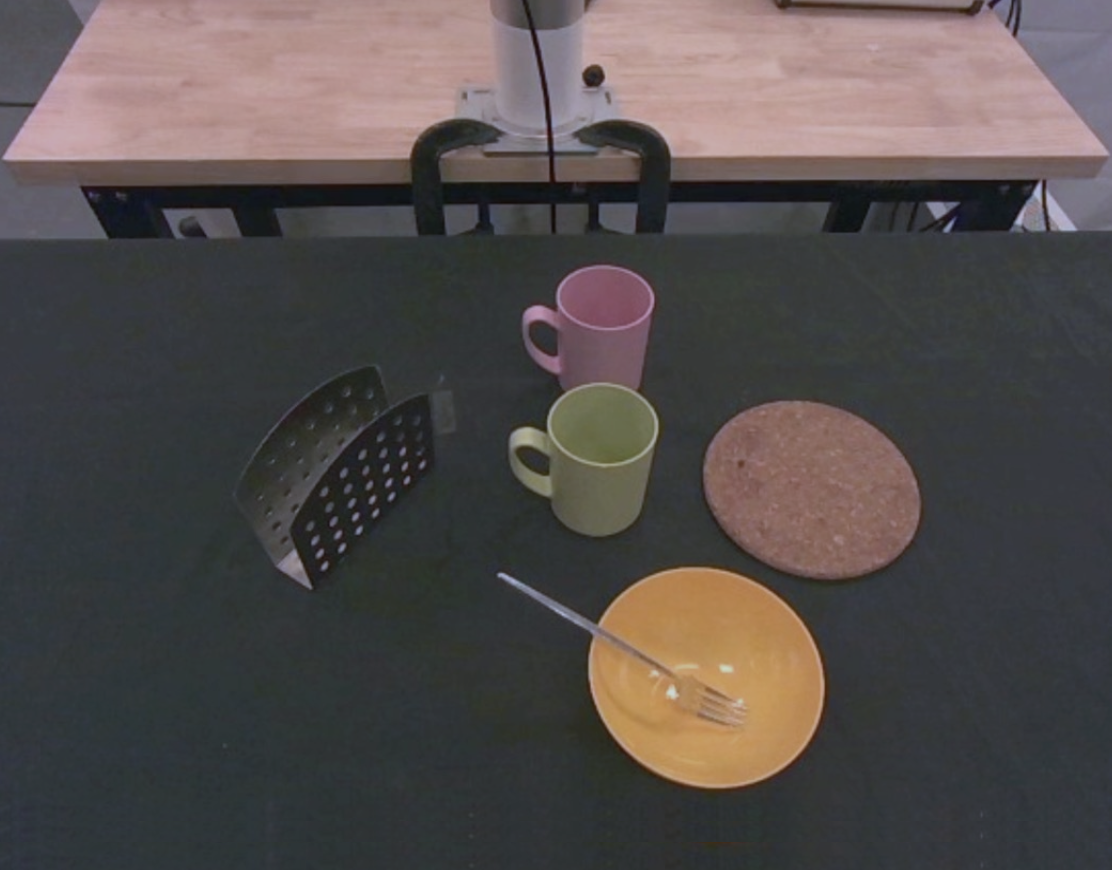
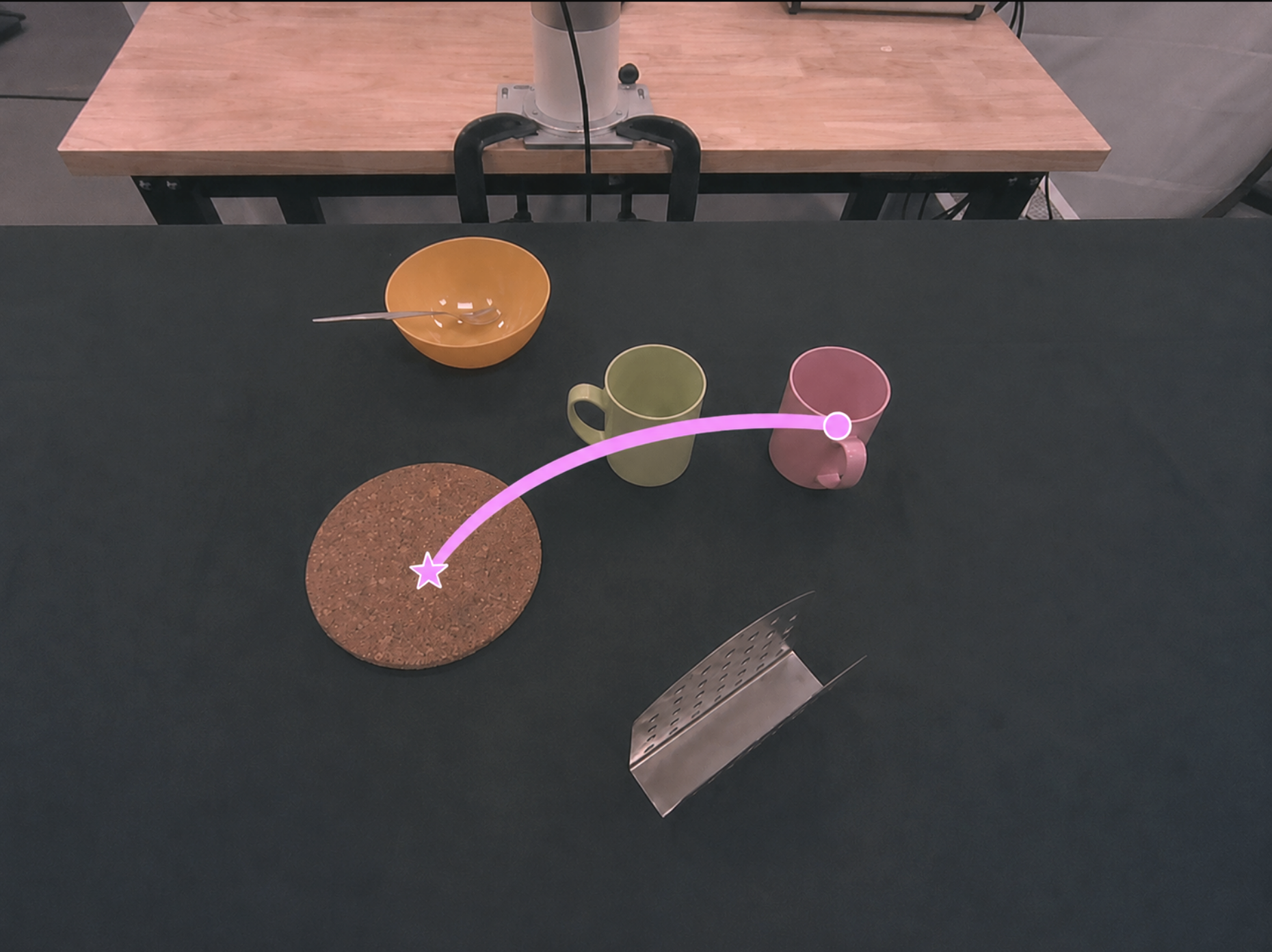
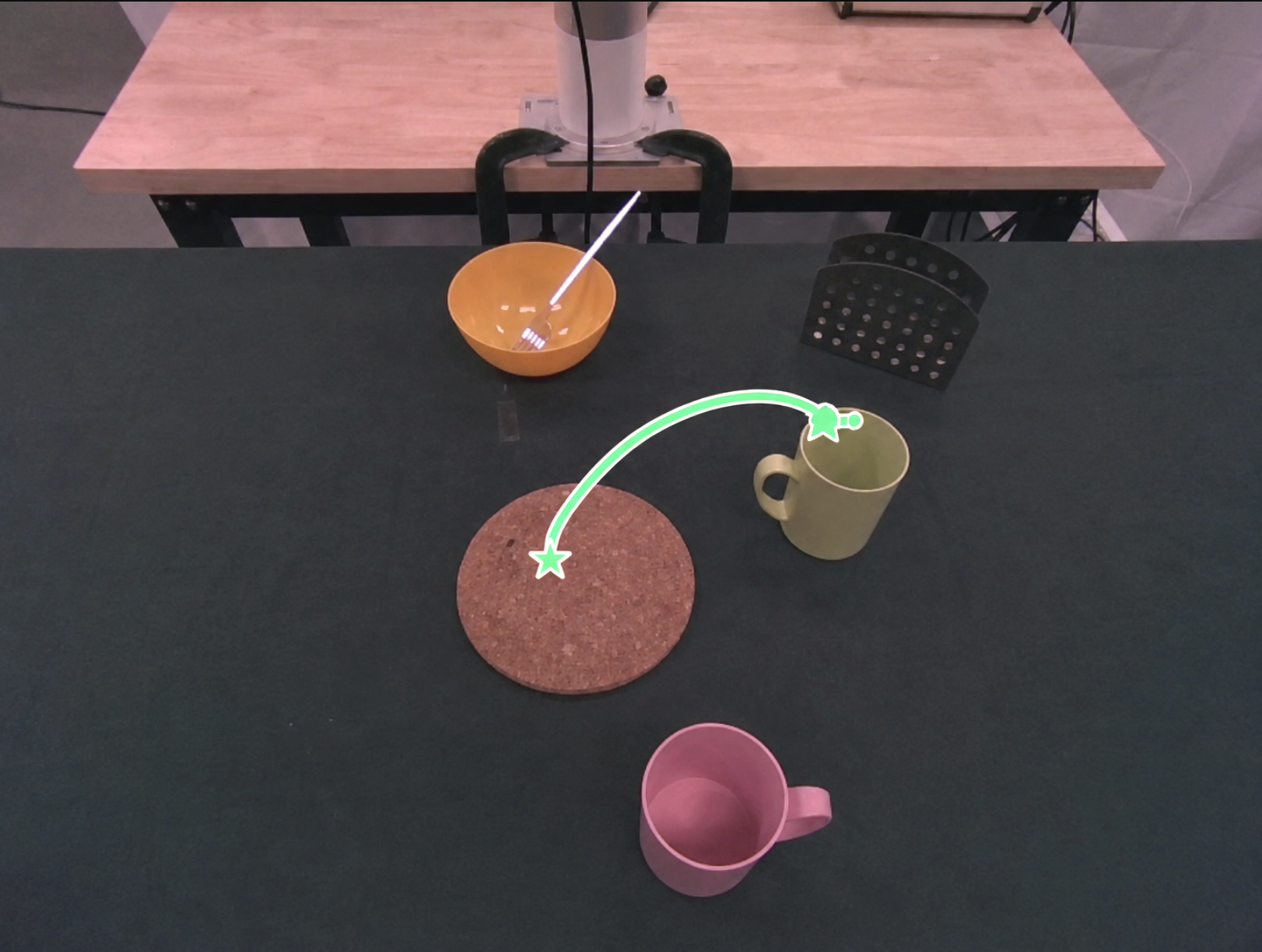
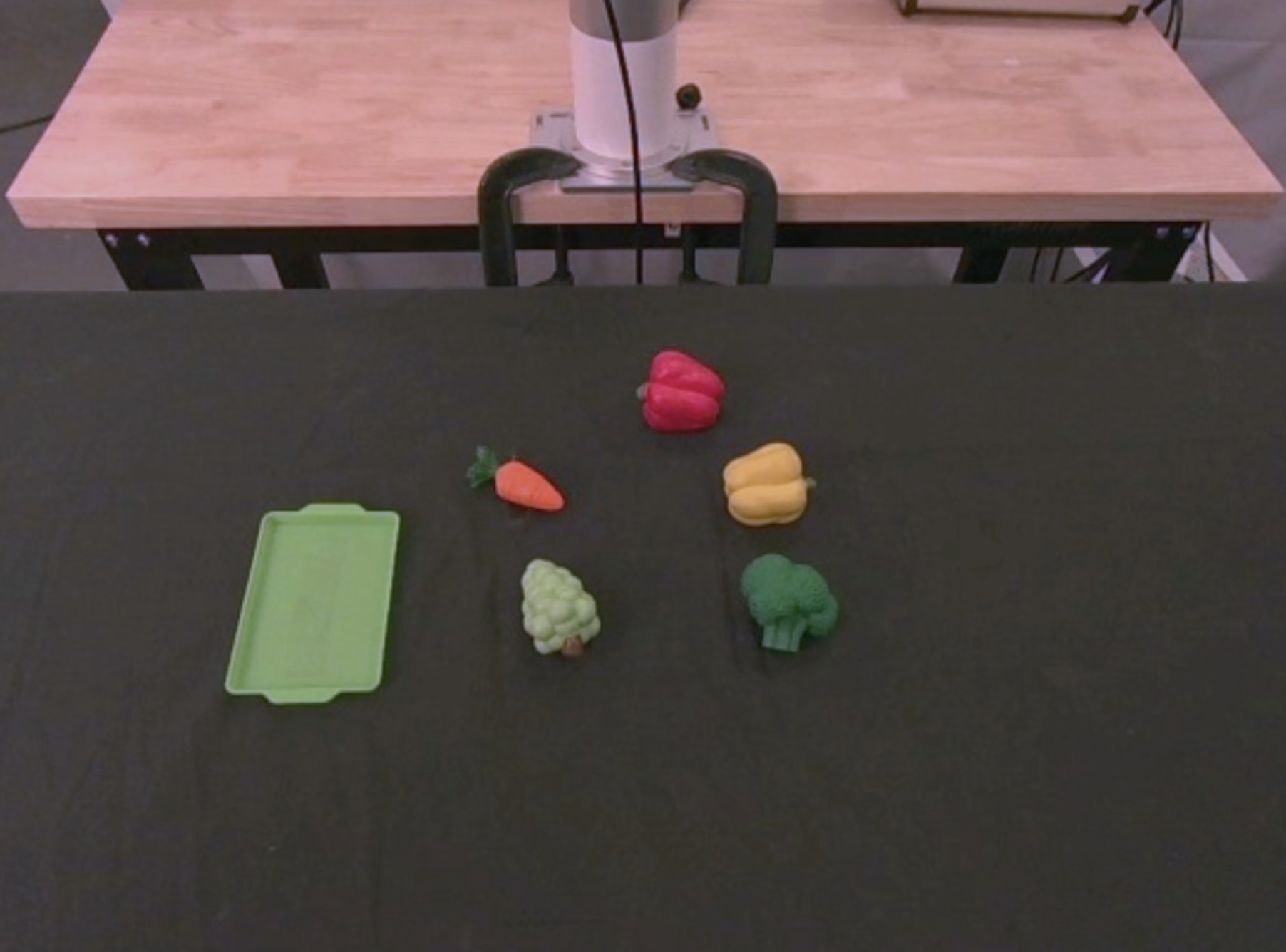
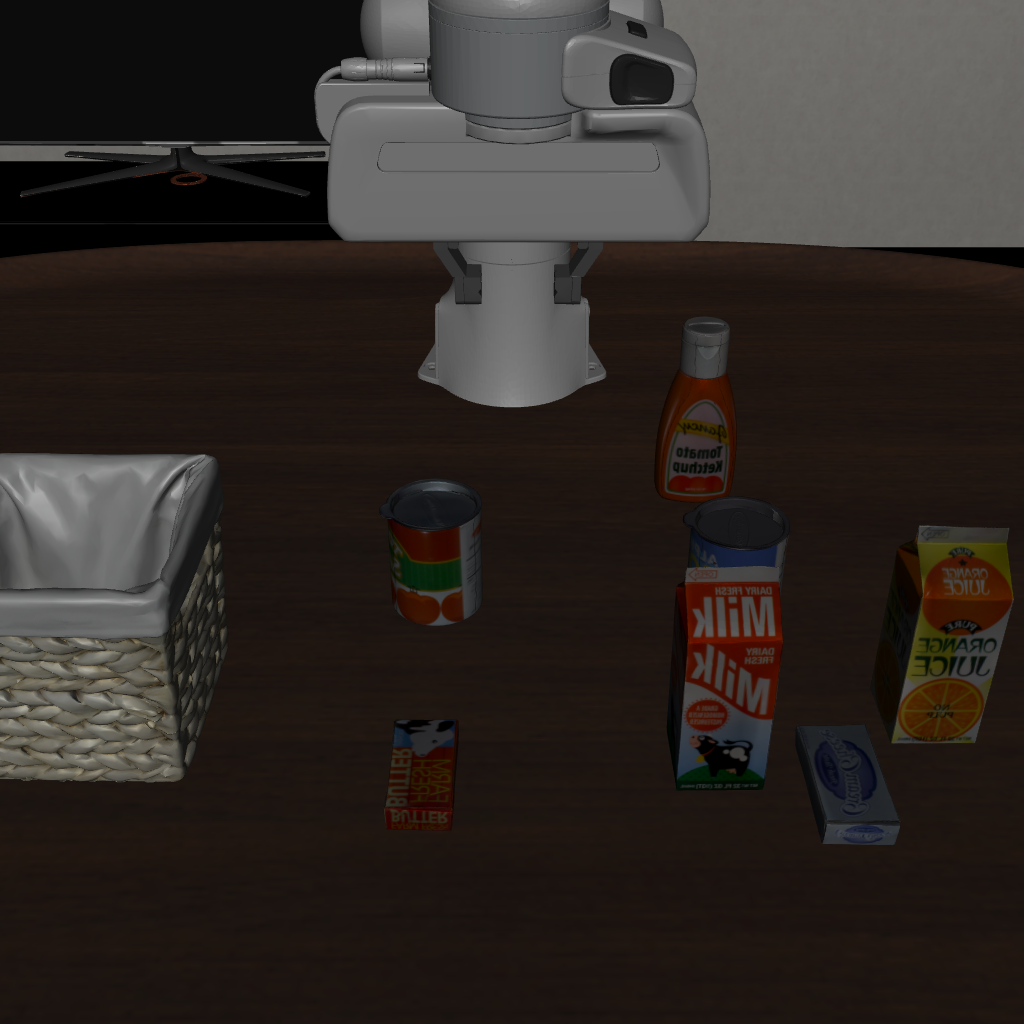
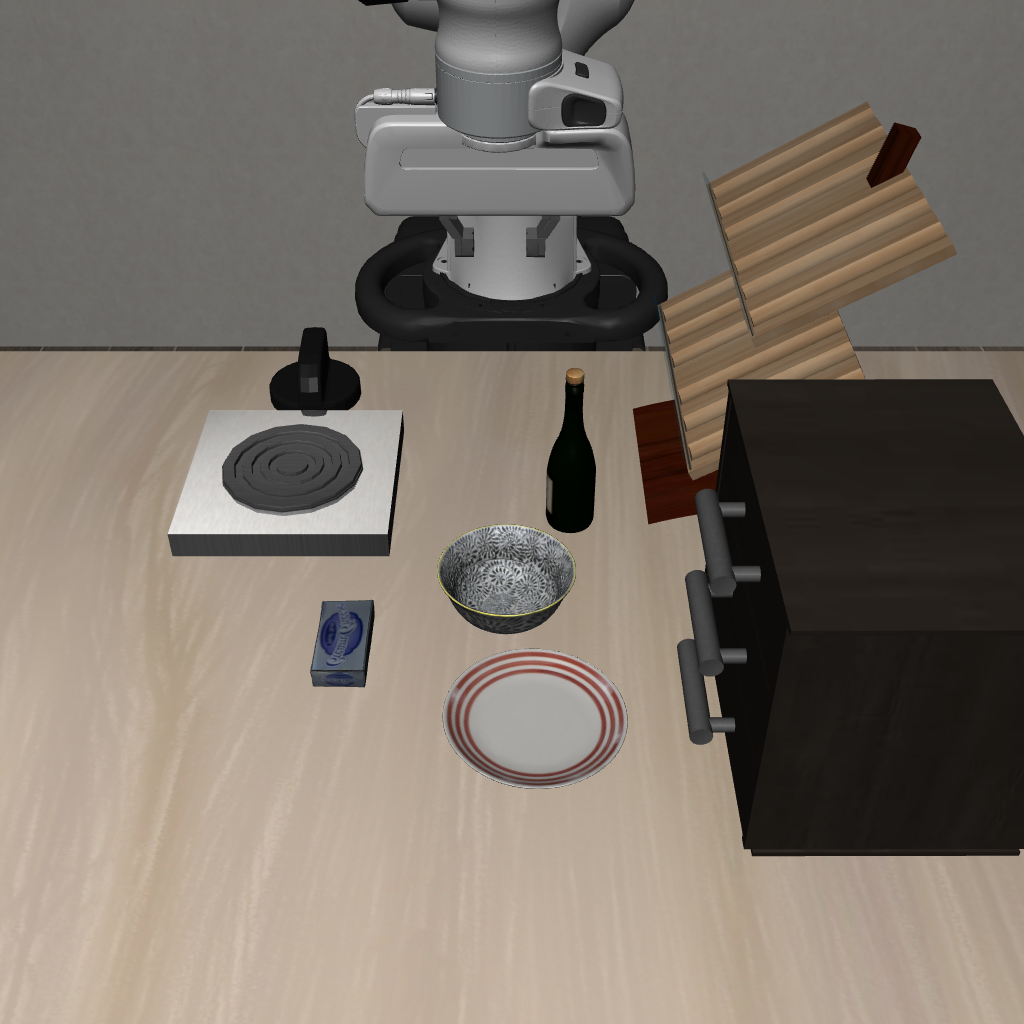
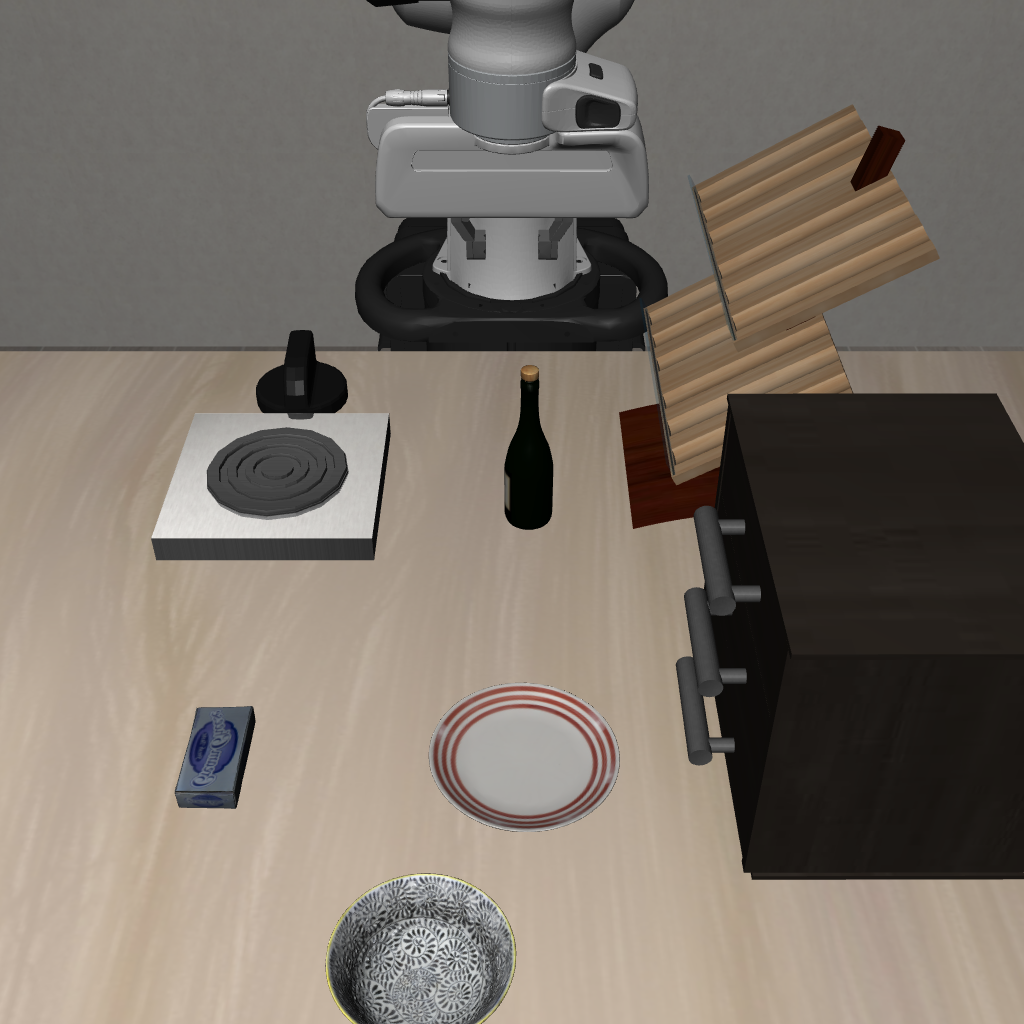
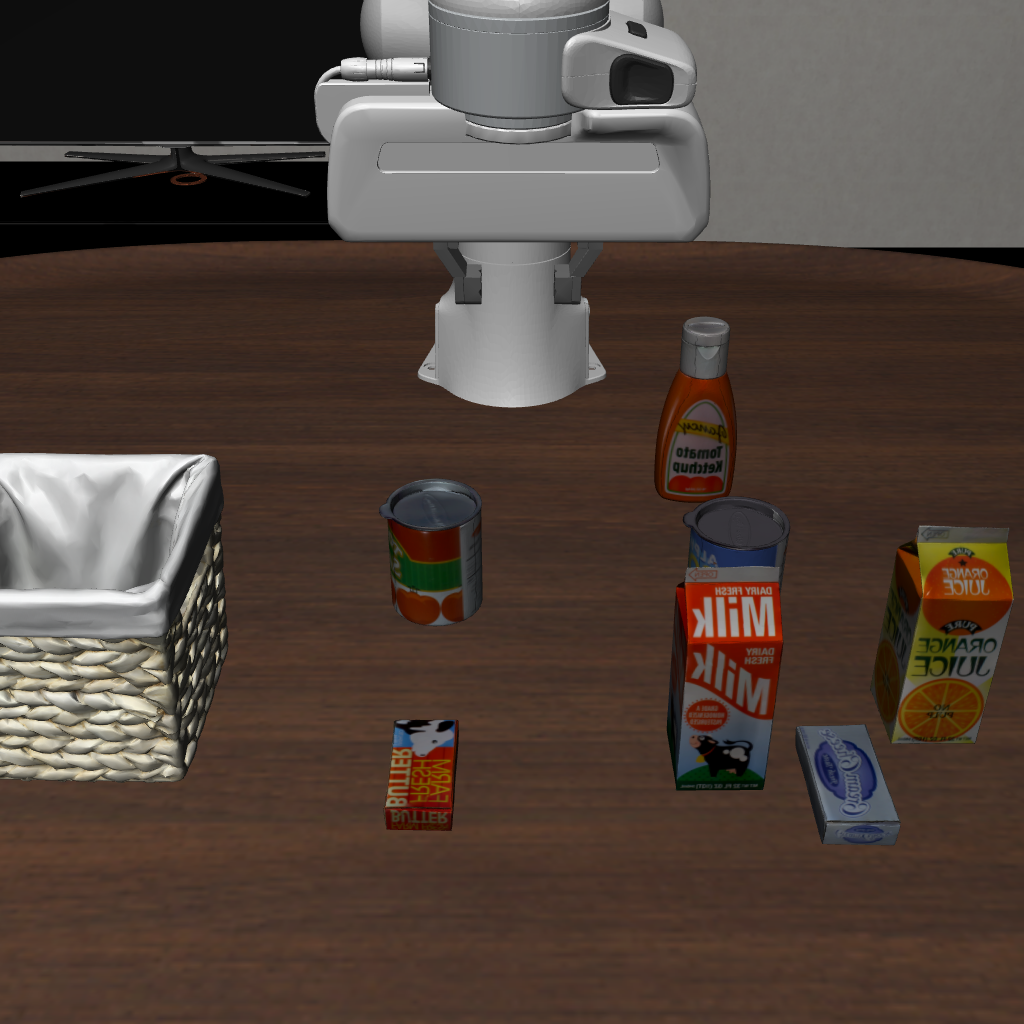
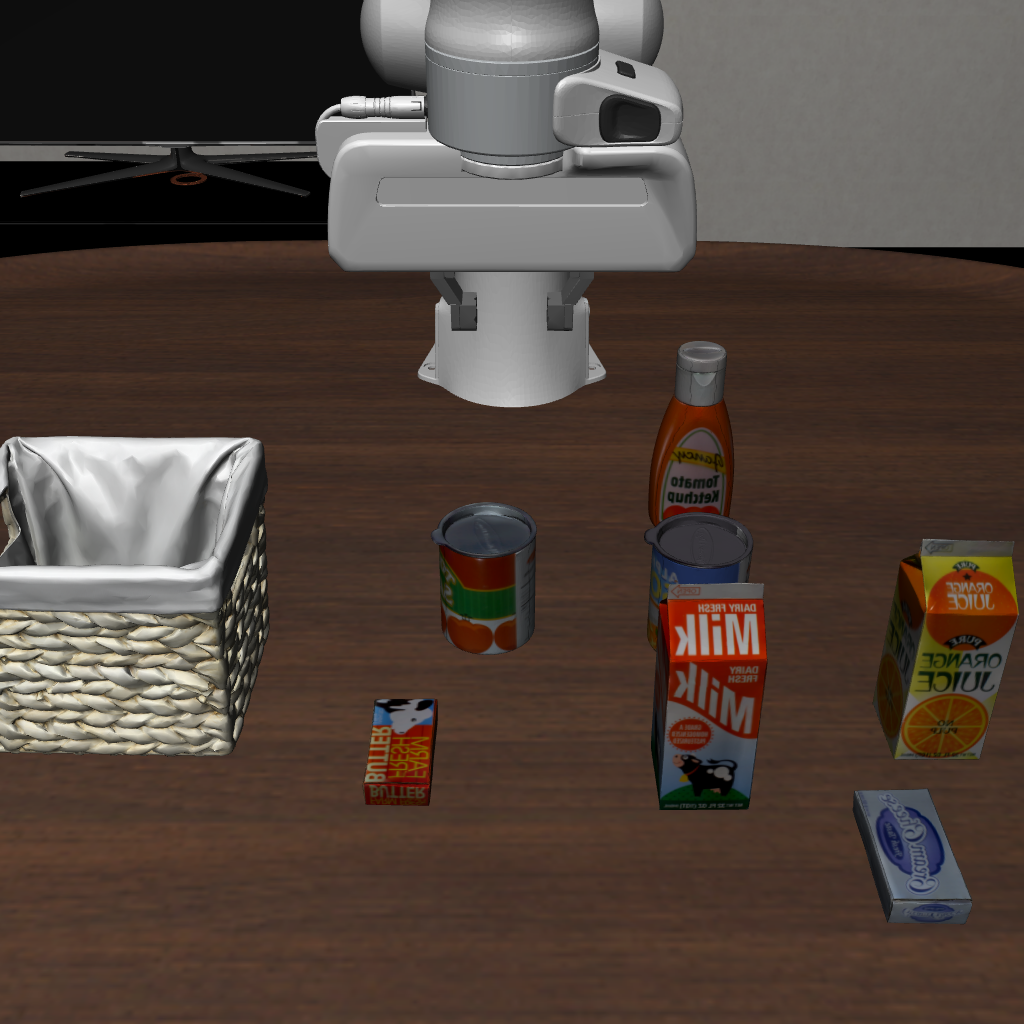
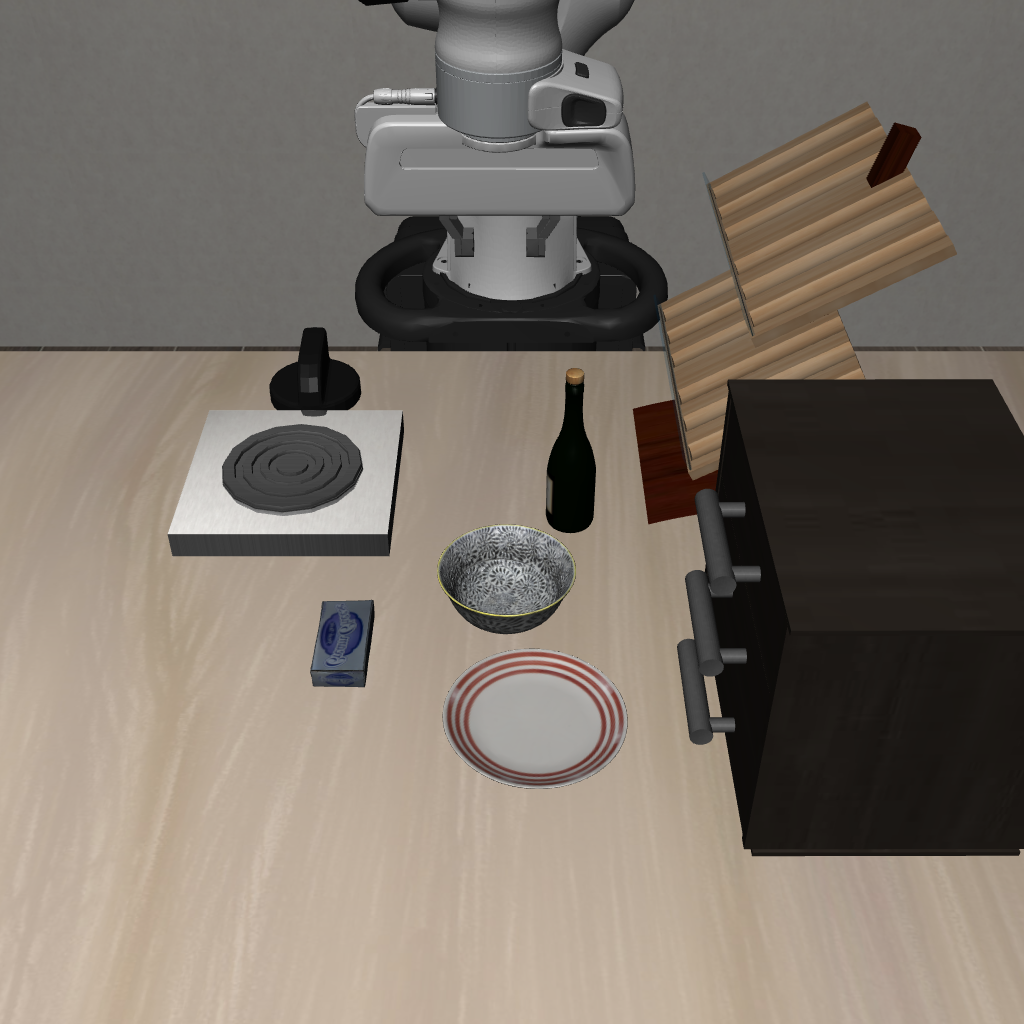
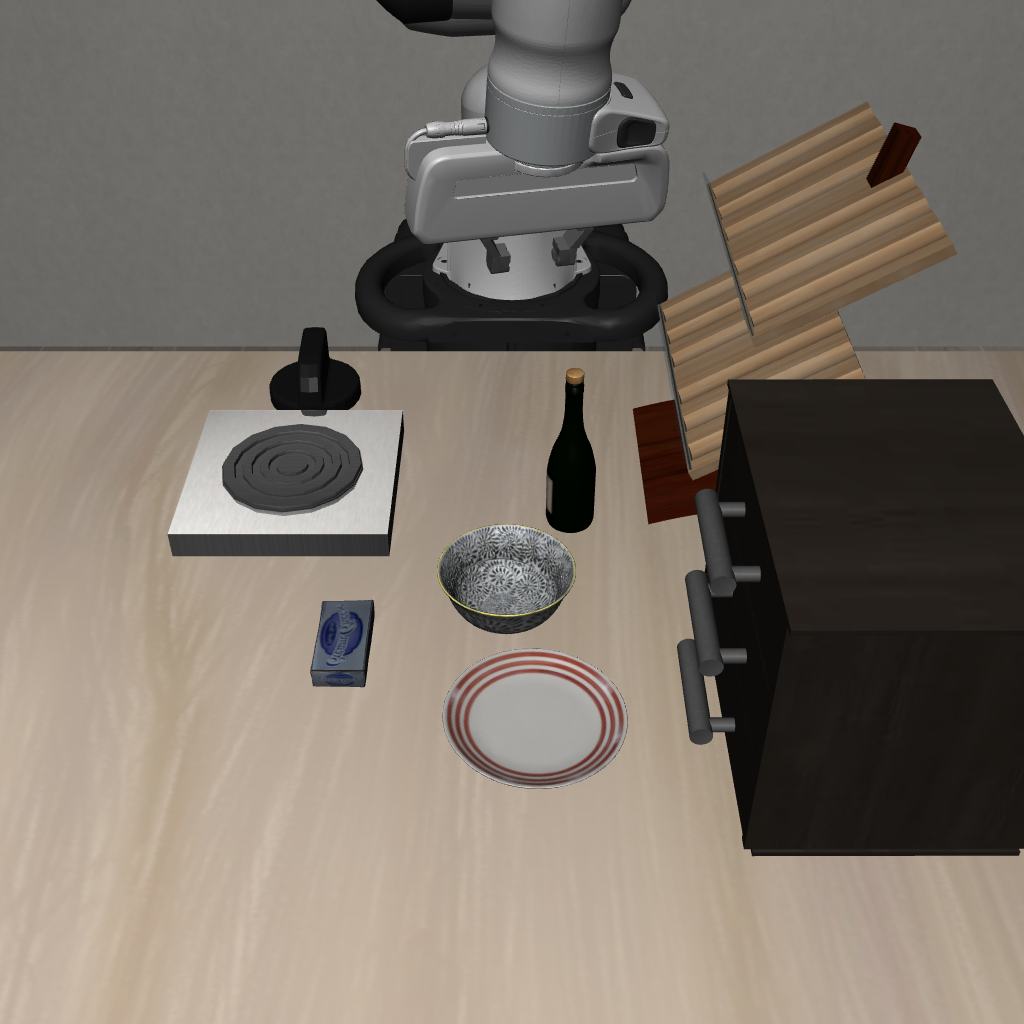
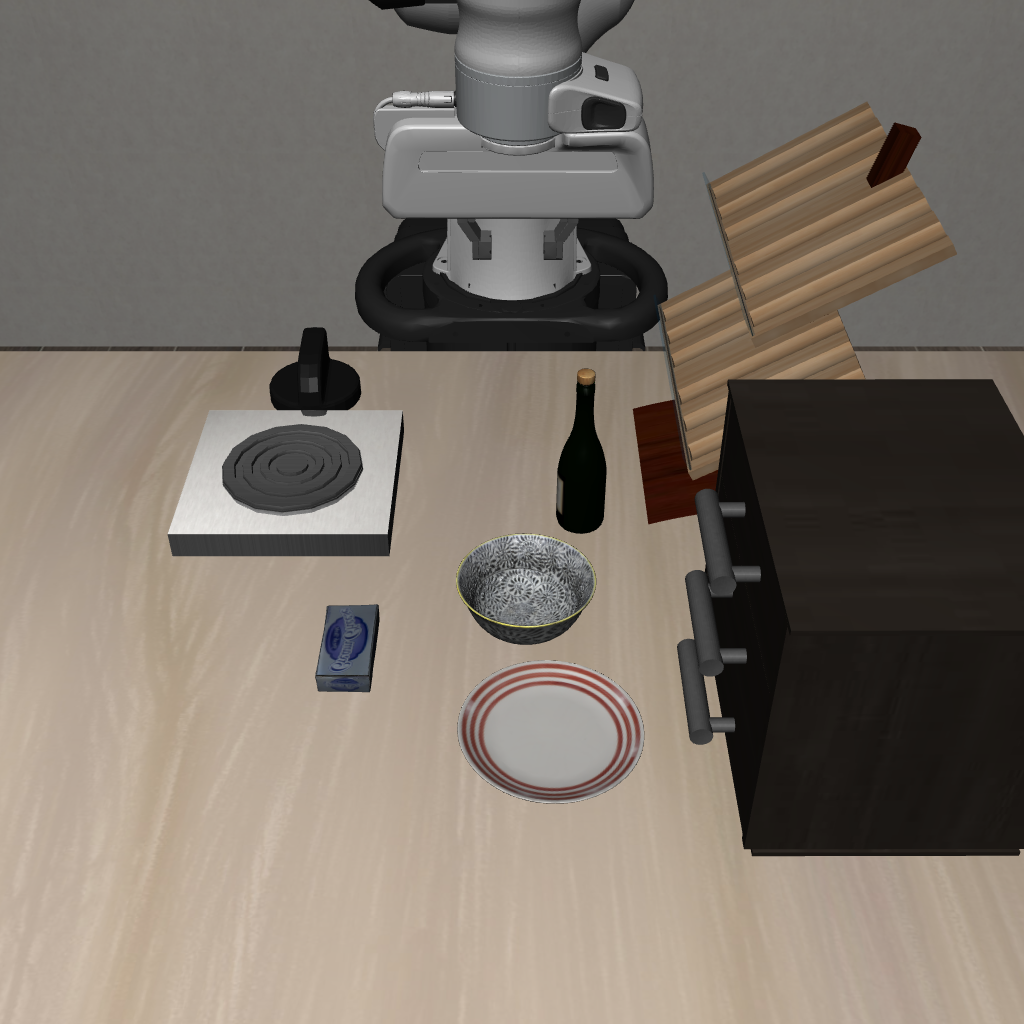
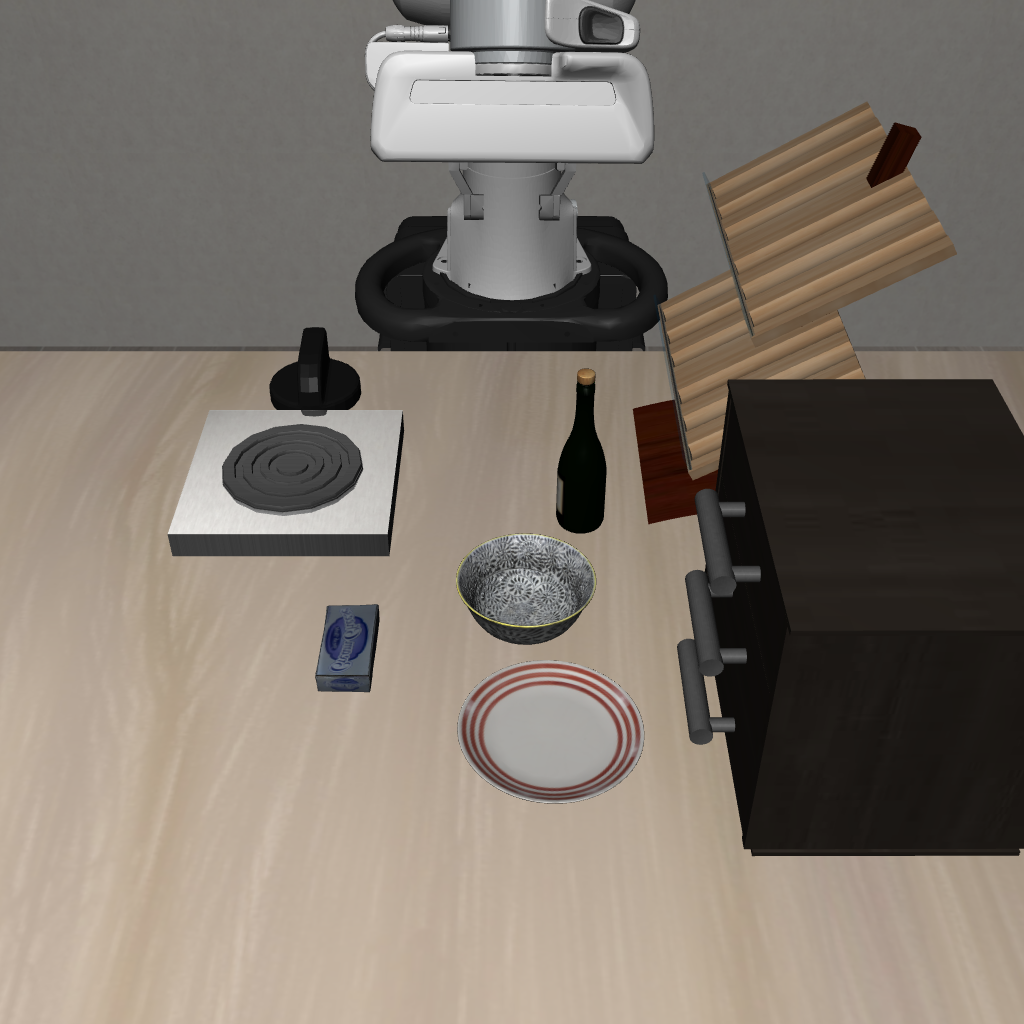
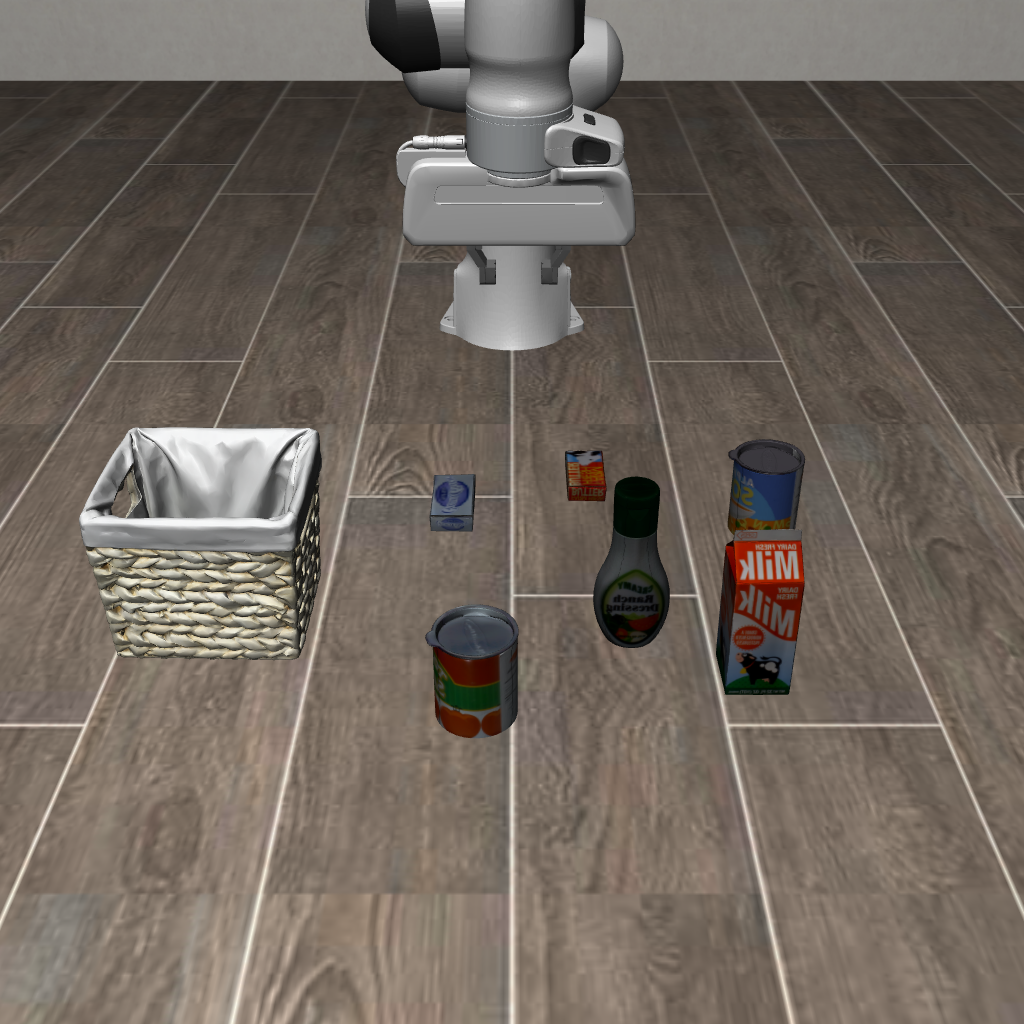
UFactory xArm7 videos show real-world Anchor-Align rollouts. Simulation videos show Anchor-Align policies (LIBERO-PRO, LIBERO-Plus, LIBERO and CALVIN).
OOD generalization with Anchor-Align
Finetuning a pretrained vision-language model (VLM) on robot demonstrations via behavior
cloning (BC) has become the standard recipe for vision-language-action (VLA) policies.
However, BC finetuning progressively overwrites the pretrained representations that support
visual and semantic generalization. Co-training on web image-text data, a common remedy,
does not prevent this; it applies language and action losses to separate observations,
leaving VLAs with language-action misalignment that standard manipulation benchmarks do
not expose.
We propose Anchor-Align, which augments BC with two objectives:
Vision-Language Anchoring distills layer-wise representations from a frozen VLM
copy to prevent this drift, while Language-Action Alignment converts each action
target into a discrete motion-direction label and jointly trains language and action
prediction on the same robot observation. We conduct real-world evaluations across eight
manipulation settings on single-arm xArm7 and bimanual YAM robots, using two VLA
architectures with regression and flow-matching action heads. Across these settings,
Anchor-Align consistently improves over BC on novel targets, layouts, and motion-sensitive
bimanual tasks requiring coordinated control. At scale in simulation, we demonstrate consistent improvements on OOD
perturbations, perceptual robustness, and long-horizon control across LIBERO-PRO,
LIBERO-Plus, and CALVIN, respectively, suggesting that preserving pretrained representations
and effective action learning are not fundamentally at odds.
Method overview
Anchor-Align converts each action target into a discrete motion-direction label and jointly trains
language and action prediction on the same observation, while distilling the policy’s hidden
states toward a frozen pretrained anchor.
Real-world generalization (xArm7 and bimanual YAM)
We compare Anchor-Align against standard BC on two VLA architectures:
VLA-Adapter (Prismatic-Qwen2.5-0.5B backbone with a Bridge-Attention regression head) and
StarVLA (Qwen2.5-VL backbone with a GR00T FM-DiT flow-matching action head). Each comparison
uses the same architecture for both methods, differing only in the training objective. We
evaluate four capabilities across two robots:
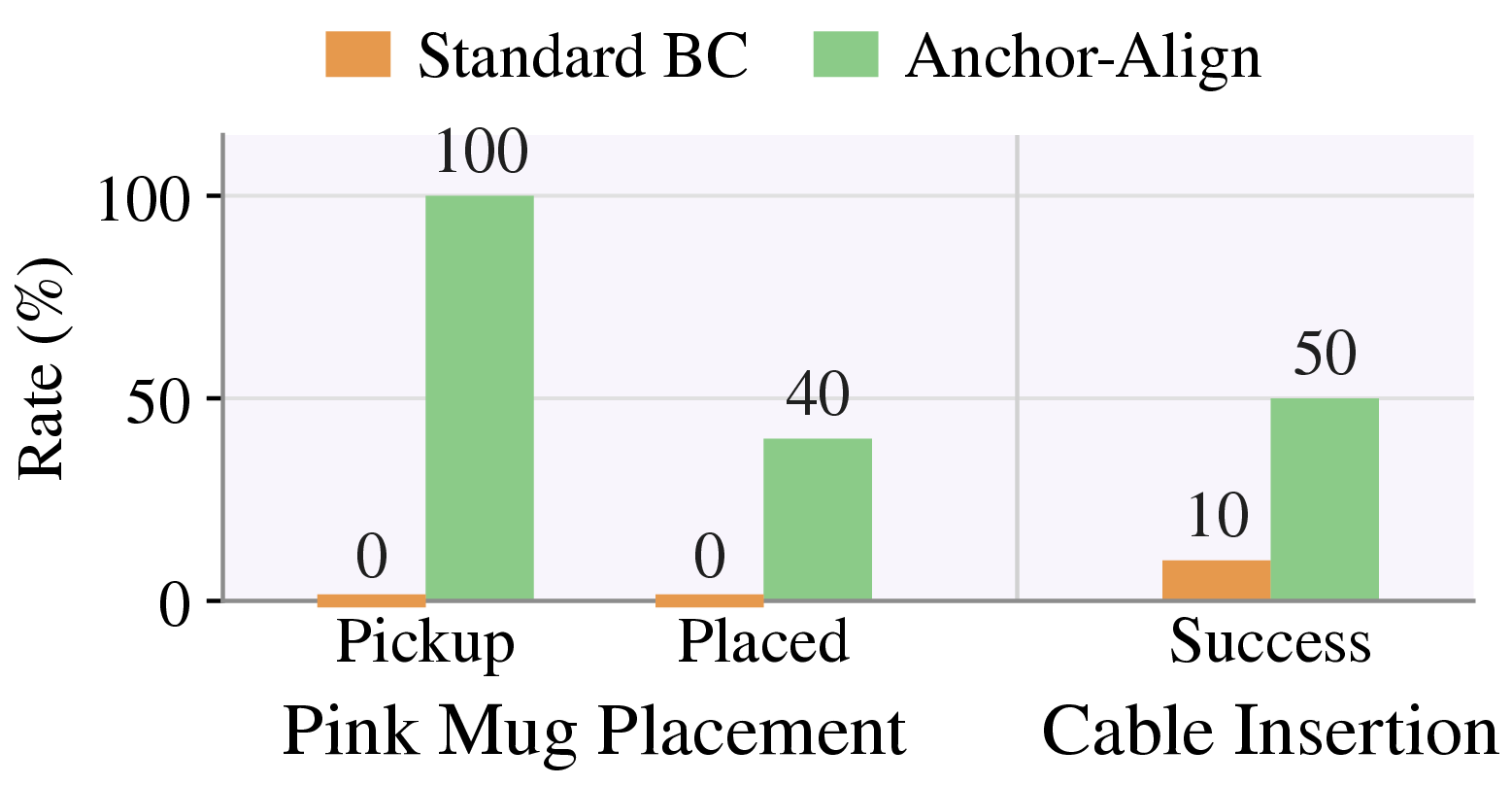
Target Generalization (OOD) on the single-arm xArm7: the language-specified target changes at test time (Pink Mug Placement, Cable Insertion).
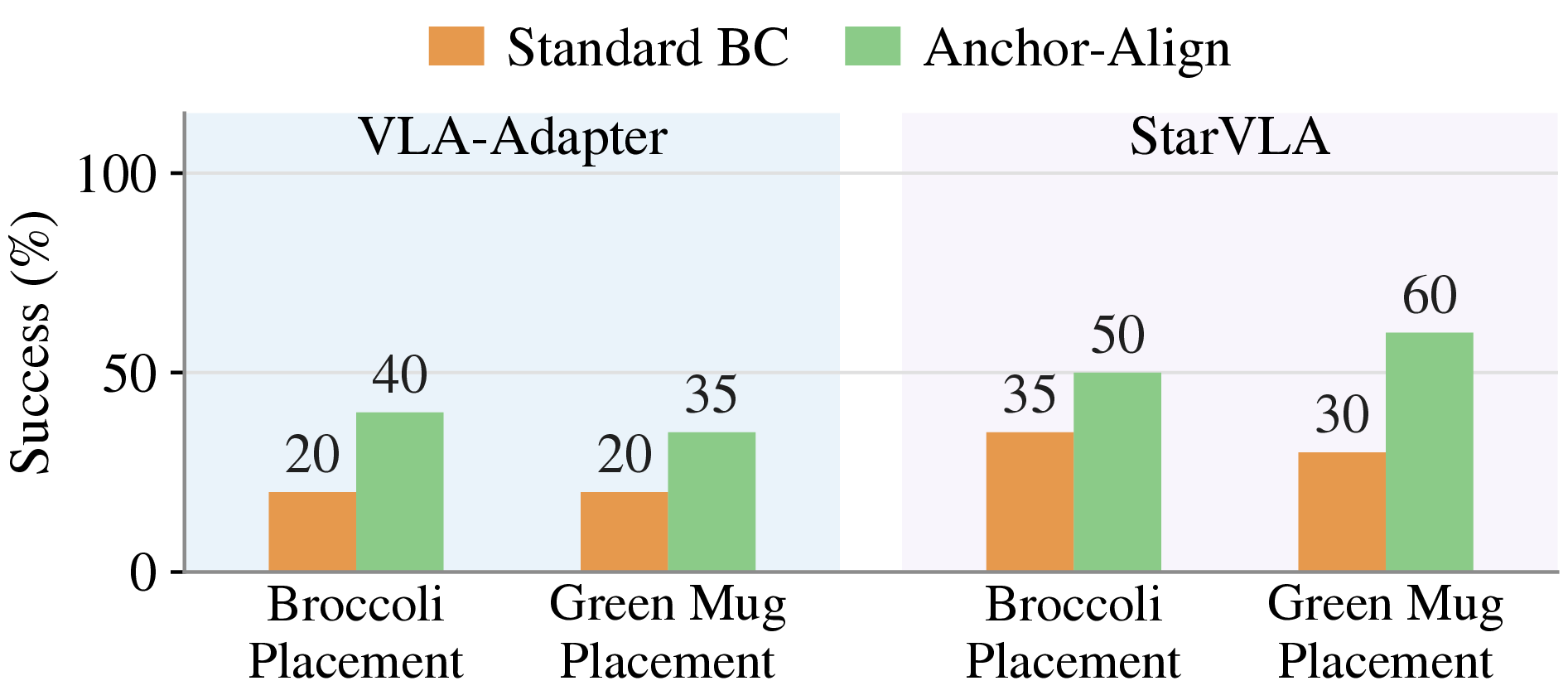
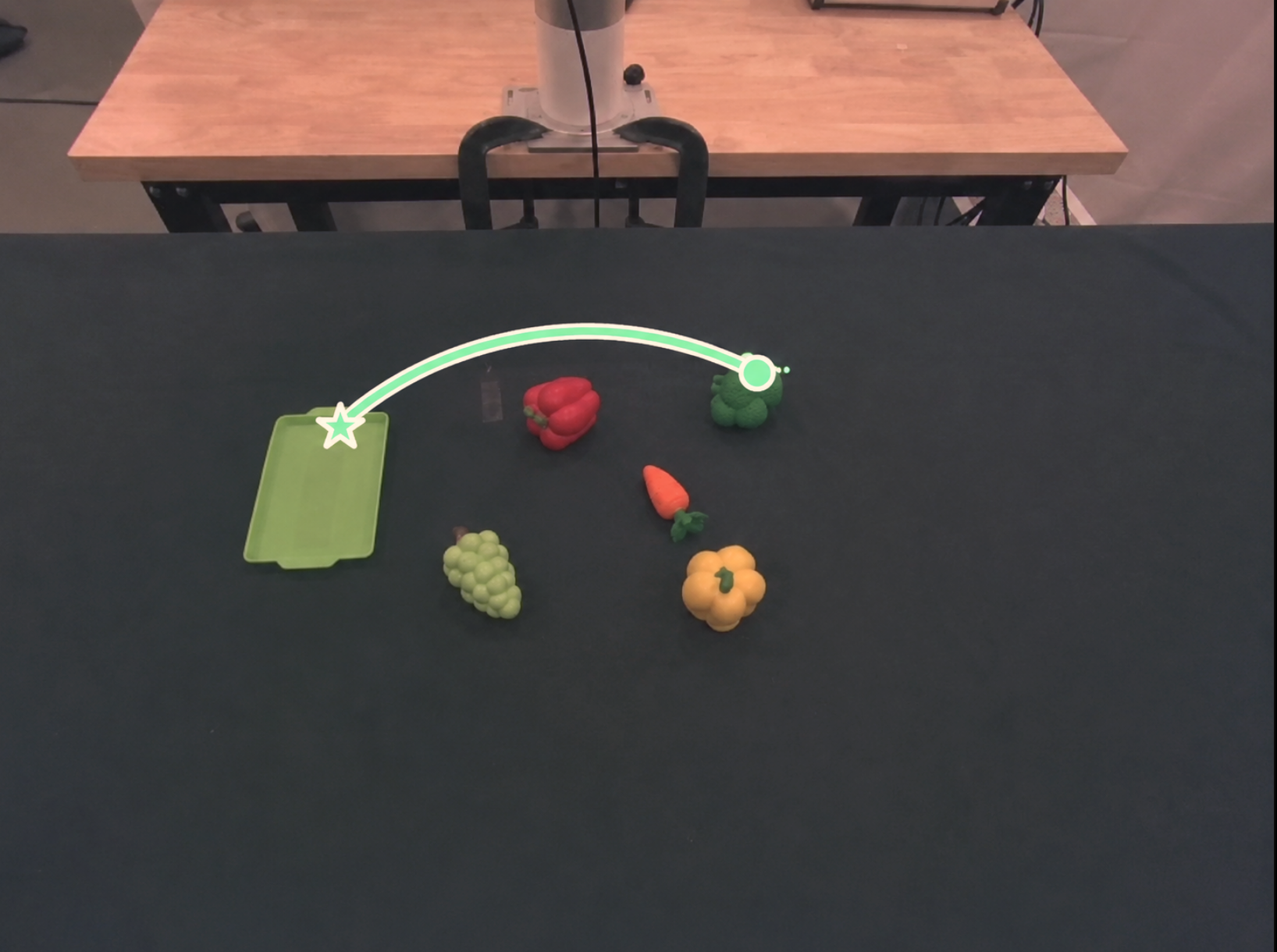
Spatial Generalization (OOD) on the xArm7: objects and distractors are moved to configurations unseen in training (Broccoli Placement, Green Mug Placement).
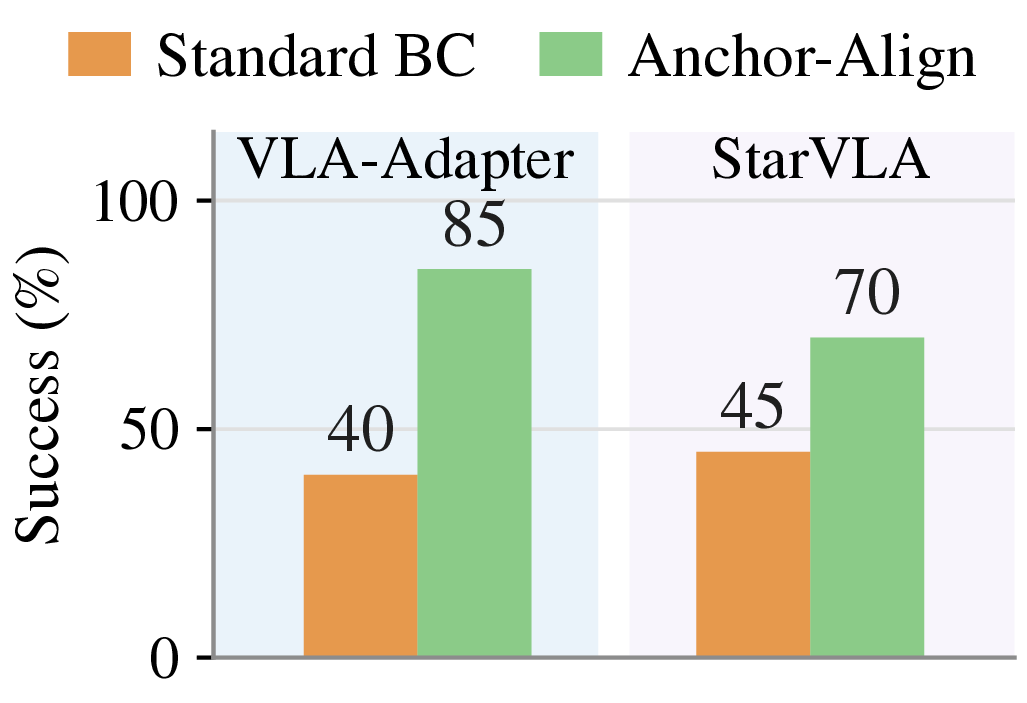
Target Grounding in Clutter on the xArm7: the policy must pick the language-specified object from among multiple distractors (Clutter Scene).
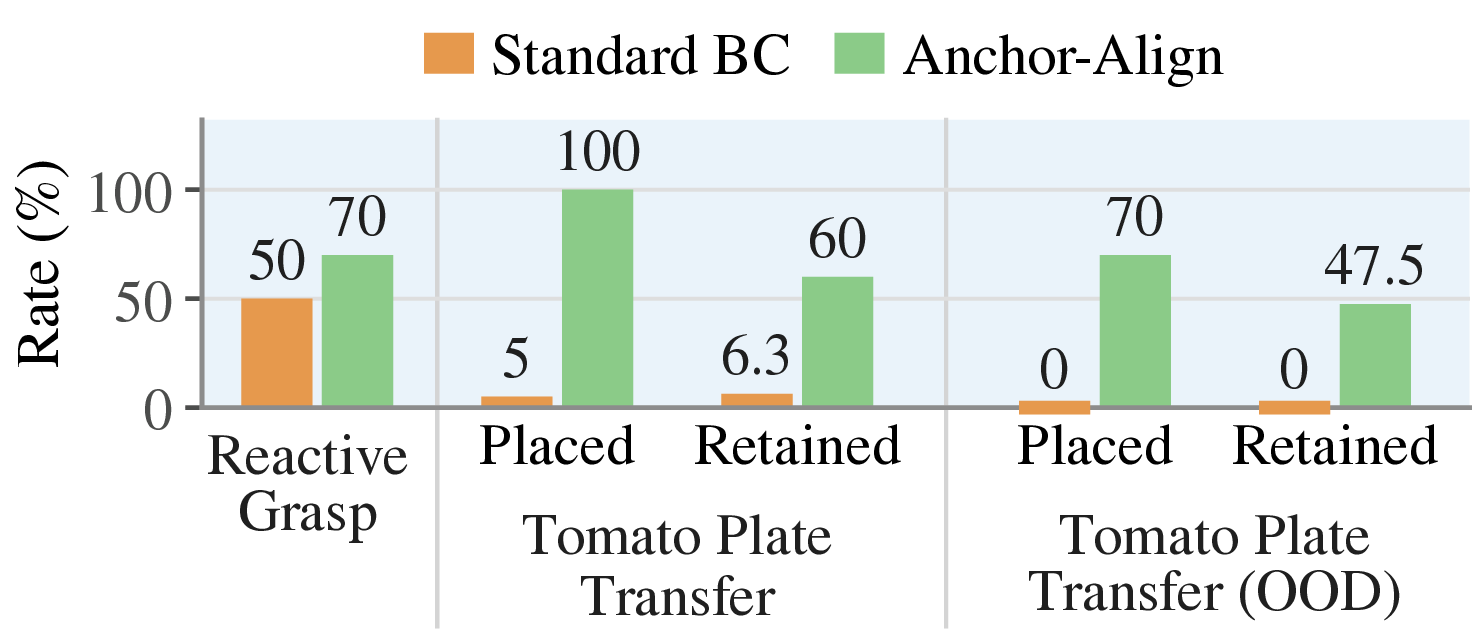
Motion Understanding and Stability on the 14-DoF bimanual YAM: tasks that require reactive execution and coordinated motion across both arms (Reactive Grasp, Tomato Plate Transfer).
1Target GeneralizationxArm7 · StarVLA2Spatial GeneralizationxArm7 · VLA-Adapter and StarVLA3Target Grounding in ClutterxArm7 · VLA-Adapter and StarVLA4Motion & Stabilitybimanual YAM · VLA-Adapter
Success rates (%) over 20 rollouts per method and condition. In (1), Pickup and Placed refer to the instructed pink mug. In (4), Placed is plate-placement success and Retained is the mean percentage of the eight tomatoes kept on the plate.
🎨 Target Generalization: Pink Mug Placement
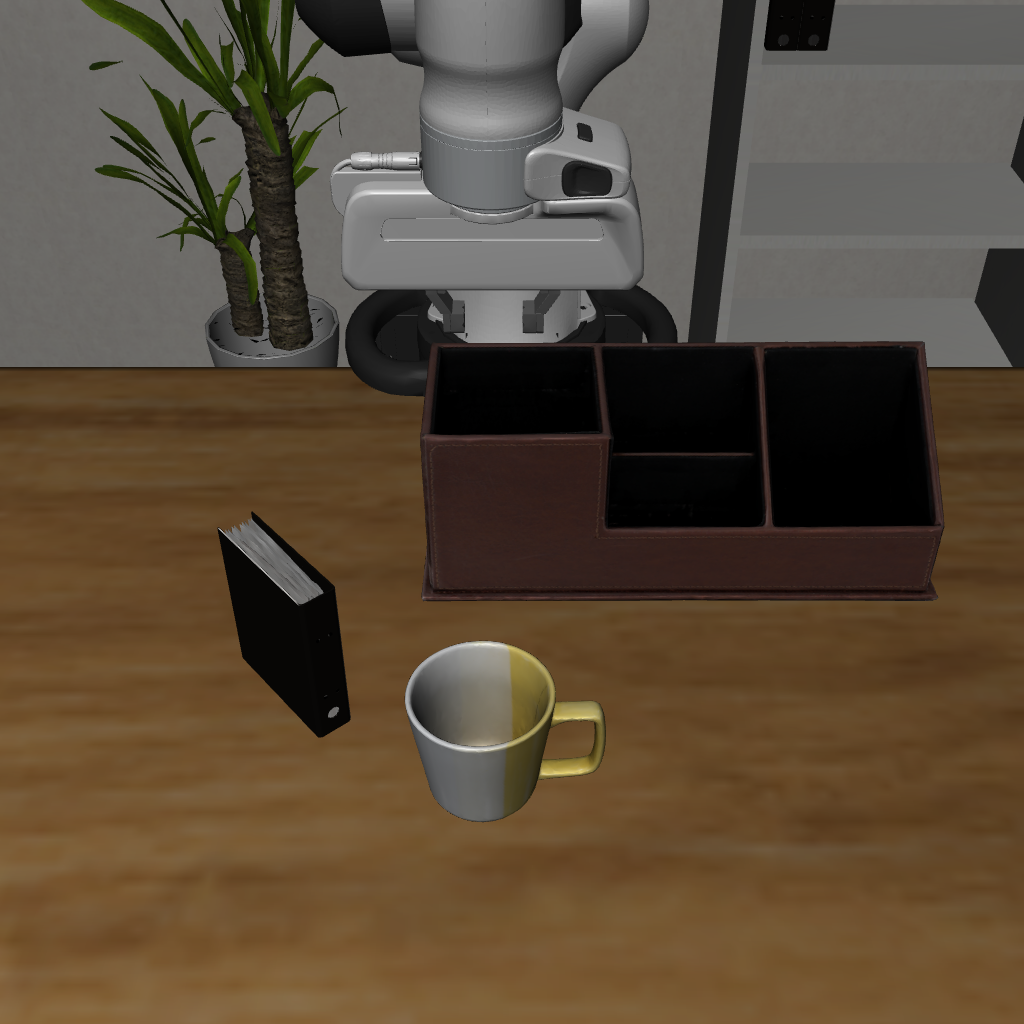
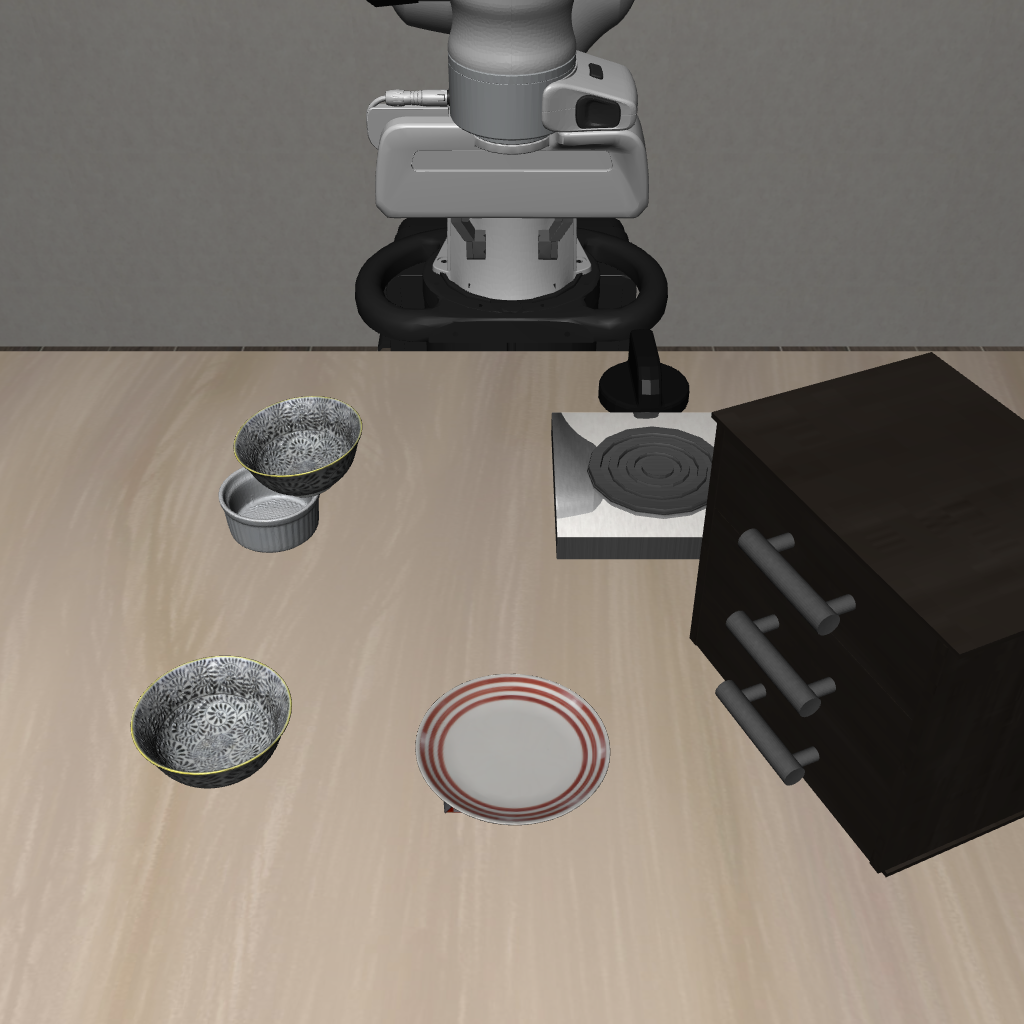
During training the policy is only told to “pick up the green mug and place it on the plate”; at test time the instructed target changes to the pink mug, in a spatial layout not seen during training. With StarVLA, Standard BC keeps acting on the training target (the green mug), while Anchor-Align picks up the instructed pink mug. Cable Insertion similarly swaps the red cable manager seen in training for a green one at test time.
Pink Mug Placement (OOD)
Task prompt: “Pick up the pink mug and place it on the plate.”
Train setupTest setupStandard BCSame VLA with Anchor-Align (ours)
The target and surrounding objects, including distractors, are relocated to configurations unseen during training, while the instruction and target stay the same: “pick up the green mug and place it on the plate.” Anchor-Align improves success on both backbones.
Task prompt: “Pick up the green mug and place it on the plate.”
Train setupTest setupStandard BCSame VLA with Anchor-Align (ours)
Anchor-Align across more scene variations
Arrangement 1Arrangement 2Arrangement 3
🧩 Spatial Generalization: Broccoli Placement
The position and orientation of the broccoli and the surrounding distractors are changed relative to the training configurations, so every evaluation is out-of-distribution. Anchor-Align improves success on both backbones (results graph 2 above).
Comparison between Standard BC and Anchor-Align
Task prompt: “Pick up the broccoli and place it on the plate.”
Train setupTest setupStandard BCSame VLA with Anchor-Align (ours)
Anchor-Align across more scene variations
🧺 Target Grounding in Clutter: Clutter Scene
The robot must pick up the object named in the instruction from among multiple distractors, with the target varied across a pineapple, a yellow pepper and a red pepper in the same scene. Anchor-Align improves success on both backbones. We show one representative Anchor-Align rollout for each target.
Target object: Yellow bell pepper
Target object: Pineapple
Target object: Red bell pepper
🤲 Motion Understanding and Stability (bimanual YAM)
Two tasks on the 14-DoF bimanual YAM that require reactive execution and coordinated motion across both arms; the Language-Action Alignment loss is applied to each arm independently, with a separate motion-direction label for each. Reactive Grasp: the robot must intercept and grasp a bottle carried by a moving person, adapting its reach and gripper closure to the target’s motion. Tomato Plate Transfer: the robot must lift a plate carrying eight tomatoes and transport it onto a box while keeping a level grasp and smooth motion, since a height mismatch between the arms tilts the plate and abrupt motion makes the tomatoes roll off. Tomato Plate Transfer (OOD) repeats the task under an unseen visual configuration, with the box covered in white paper and the workspace walls removed.
Reactive GraspTomato Plate Transfer: Anchor-Align, head and both wrist cameras
Tomato Plate Transfer prompt: “Use both arms to pick up the plate and put it onto the box.”
LIBERO-Plus OOD generalization
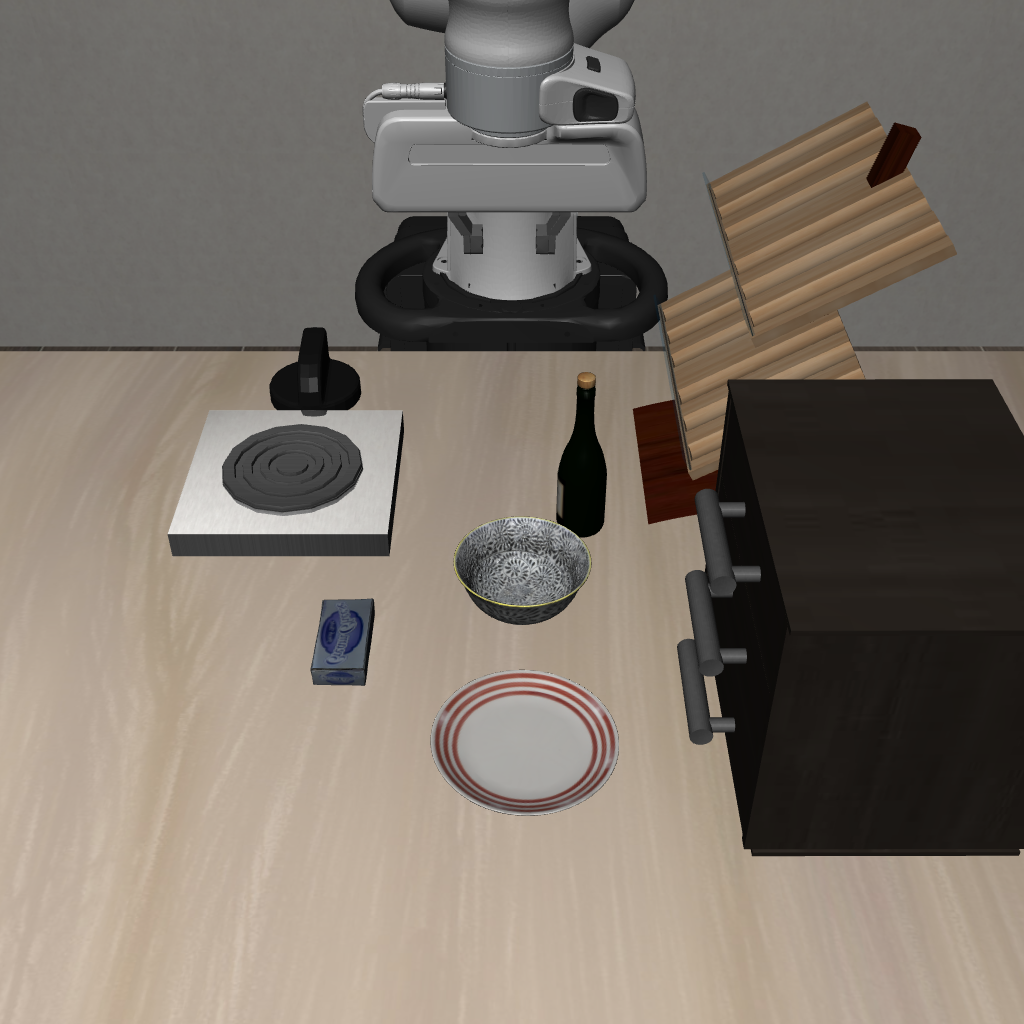
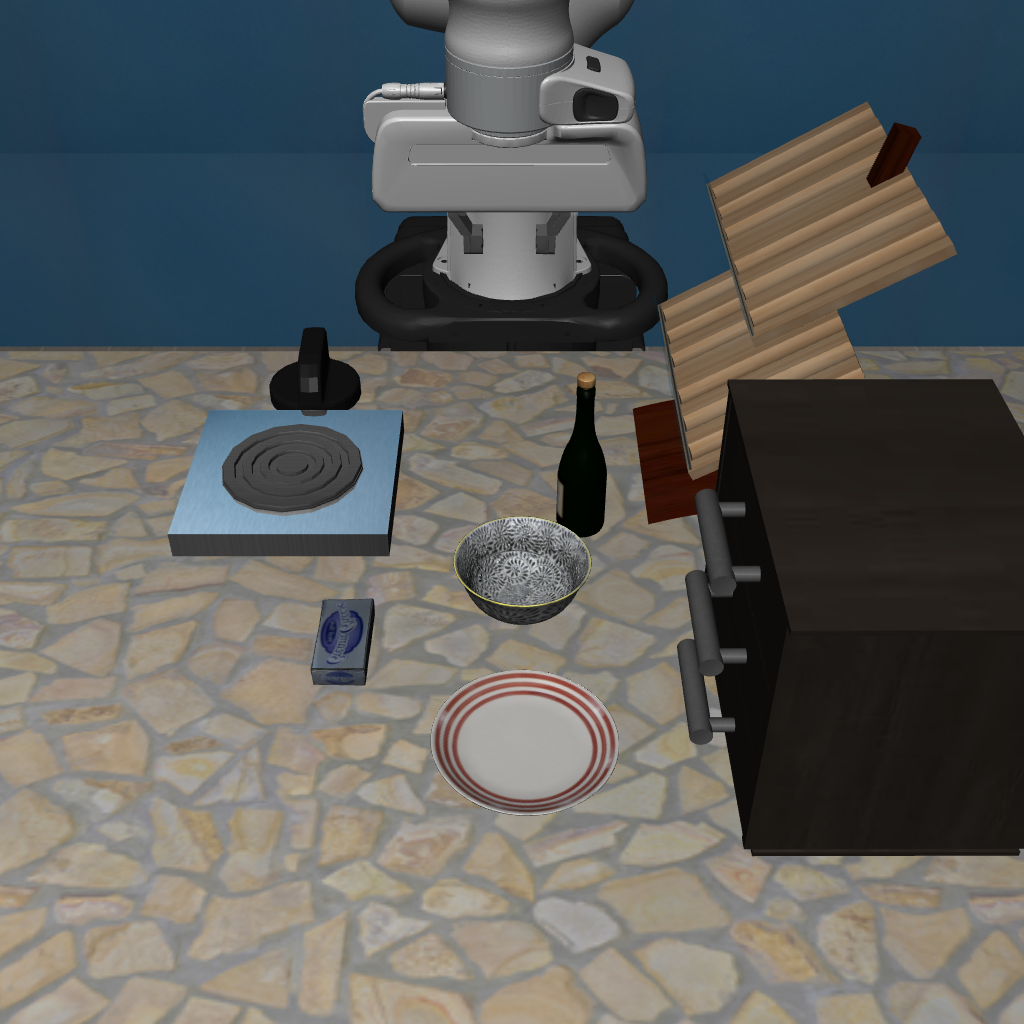
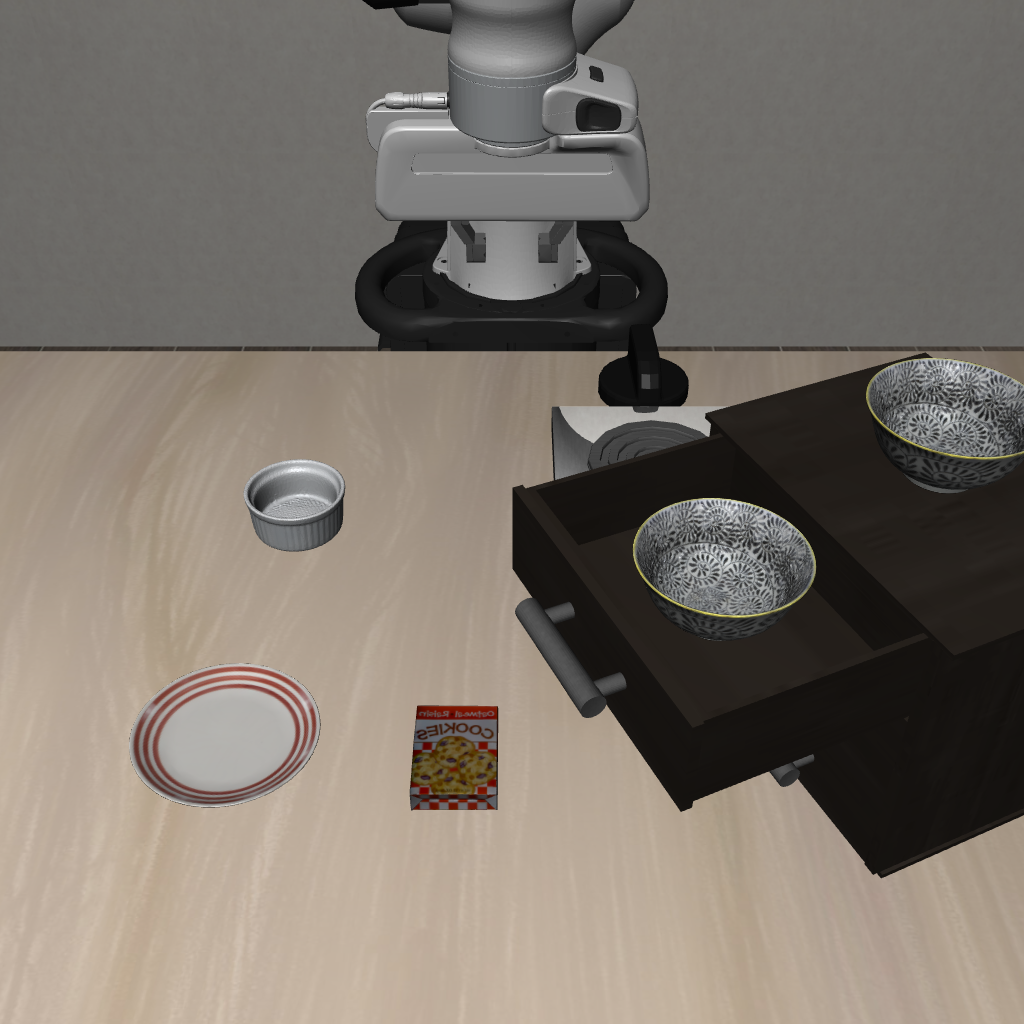
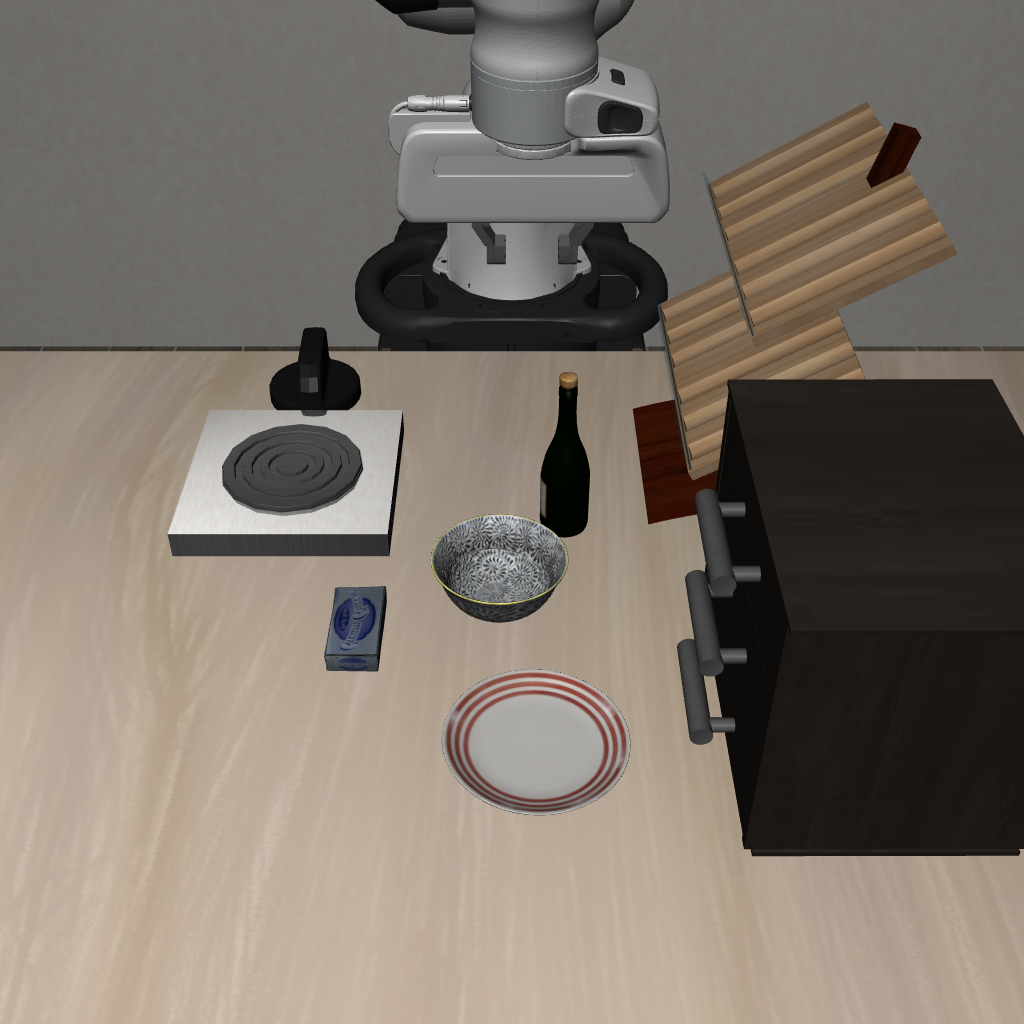
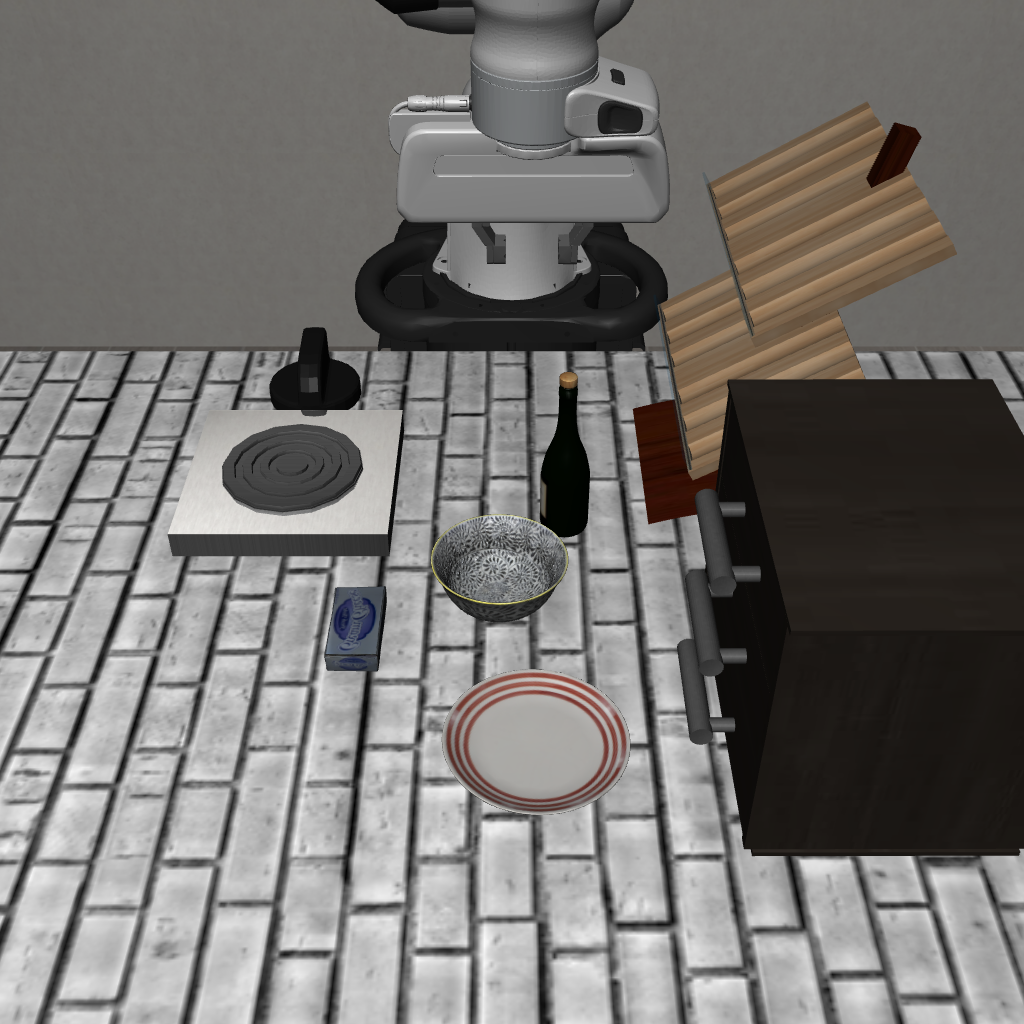
LIBERO-Plus probes perceptual robustness across seven independent OOD axes; we show six of them here. For each axis we pair the Standard BC baseline (failure) with Anchor-Align (success) on the same initial condition.
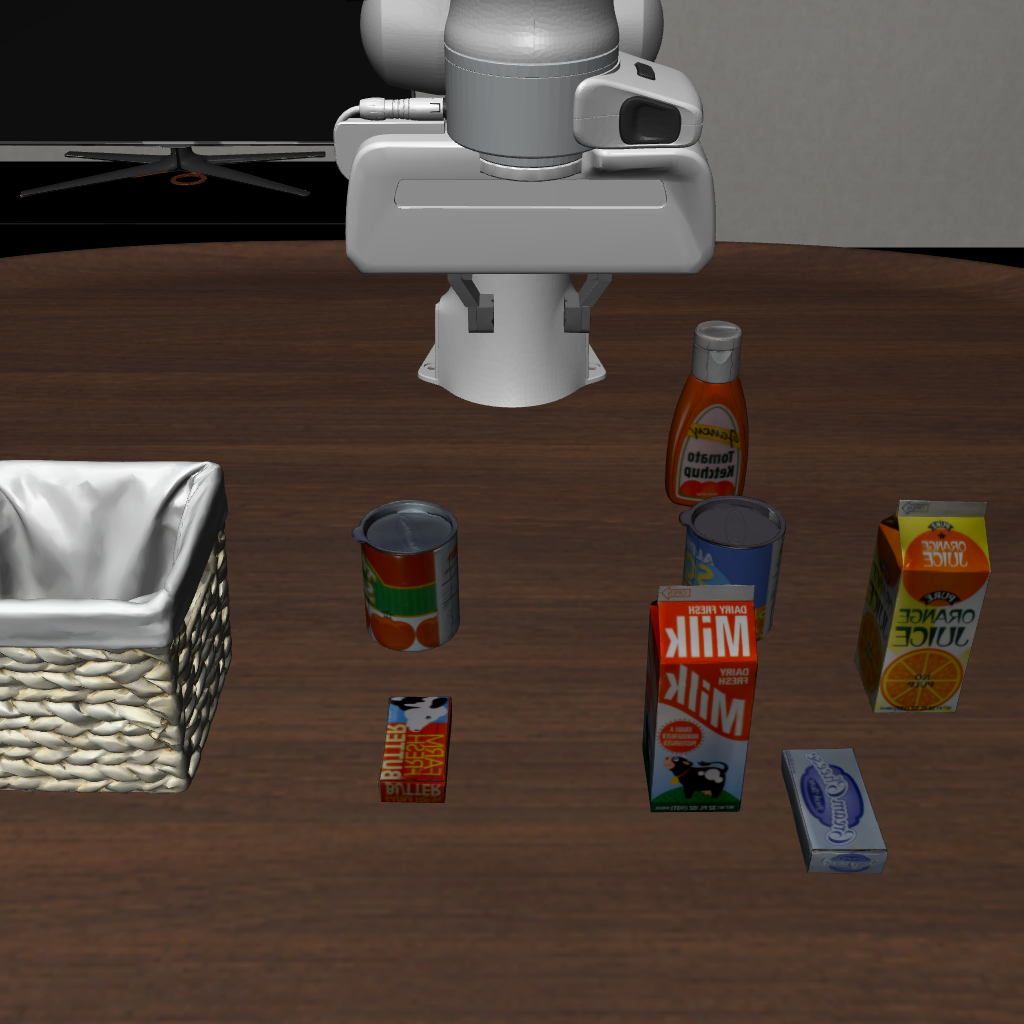
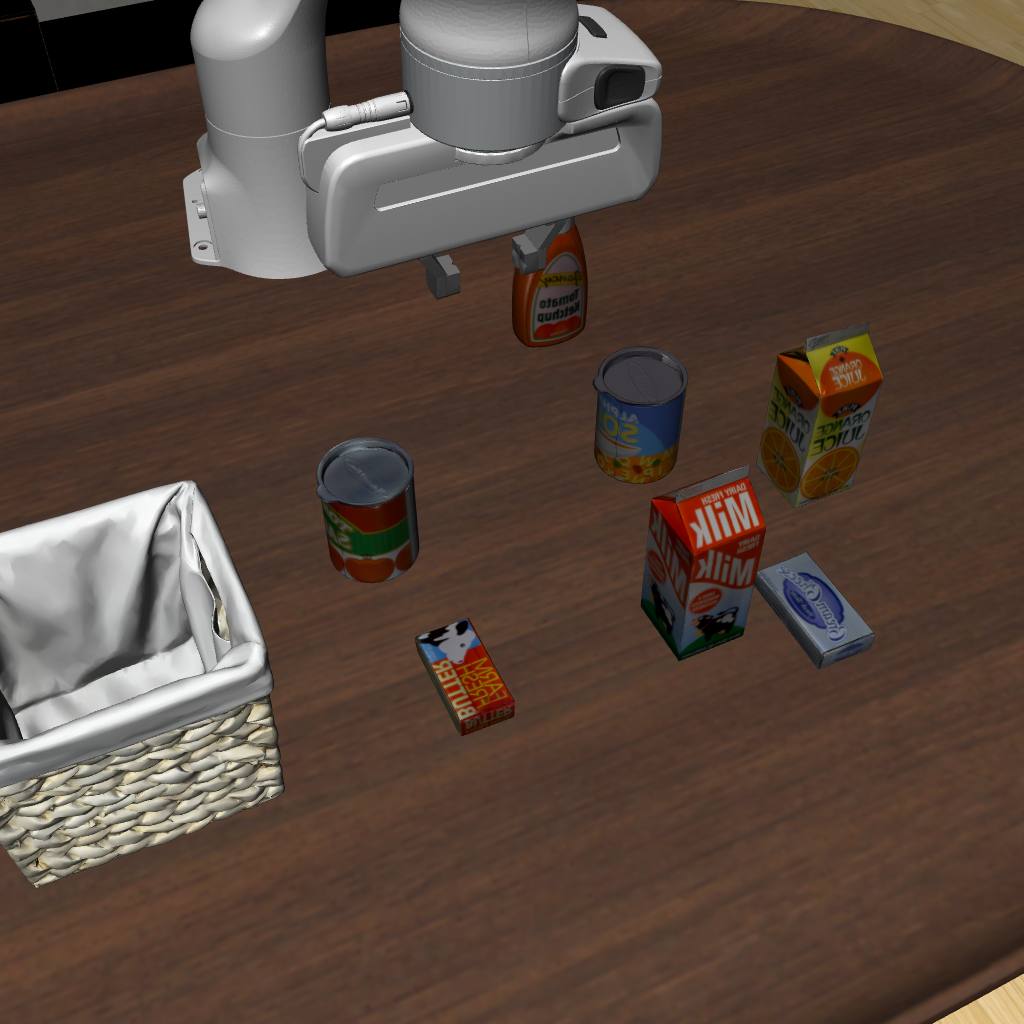
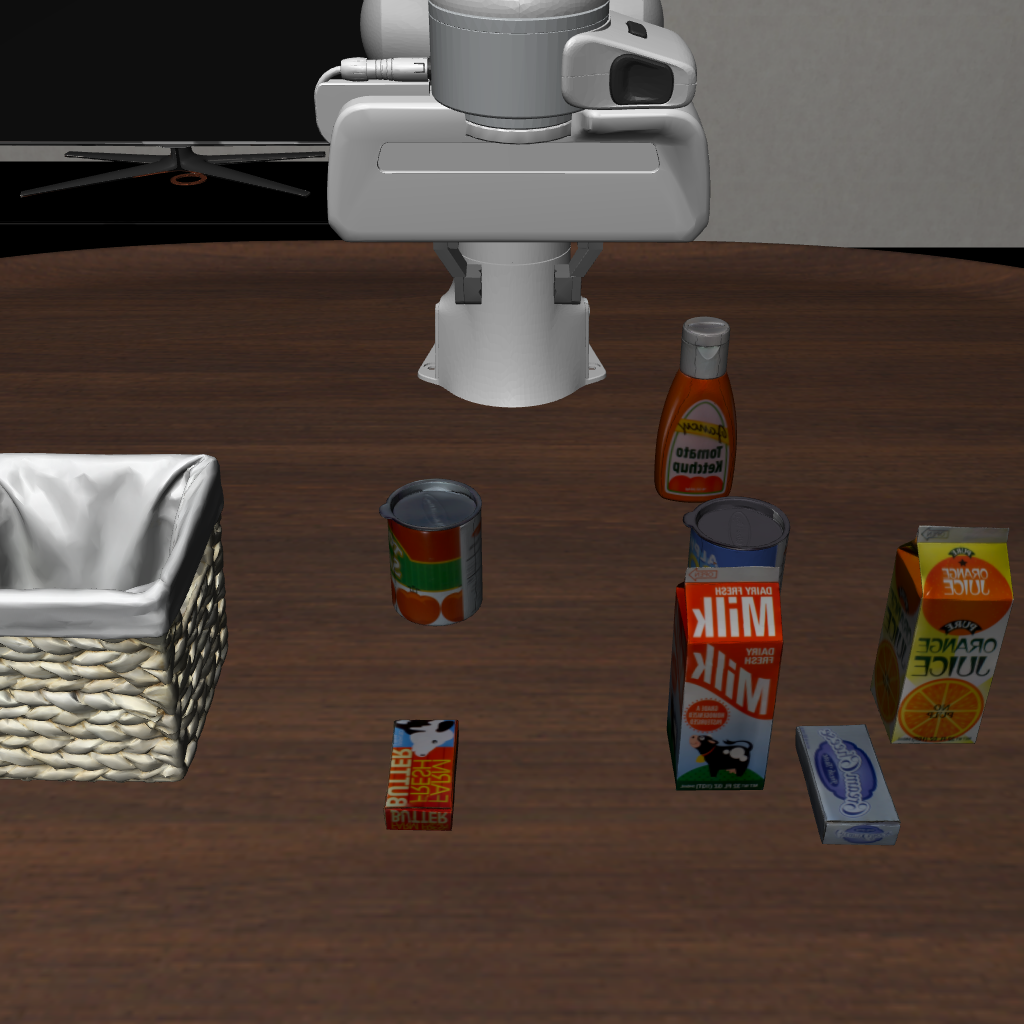
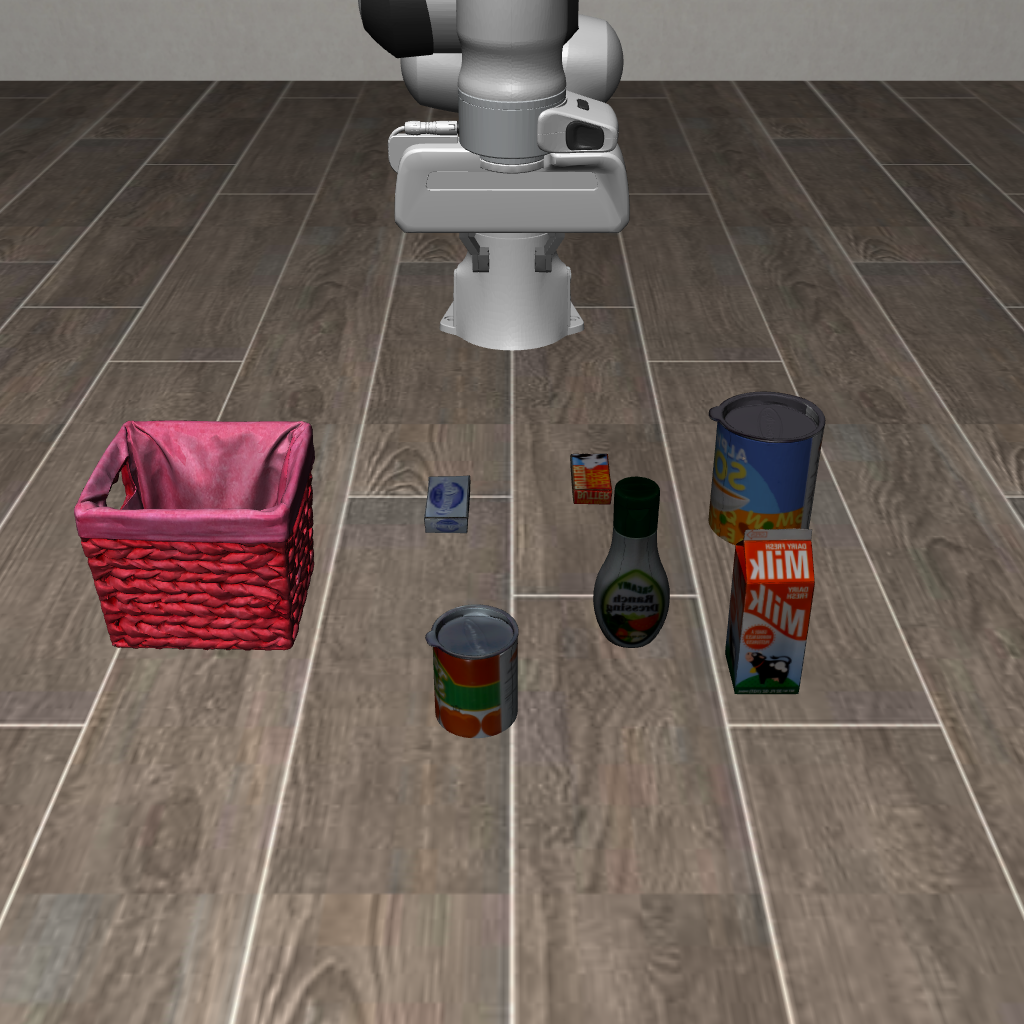
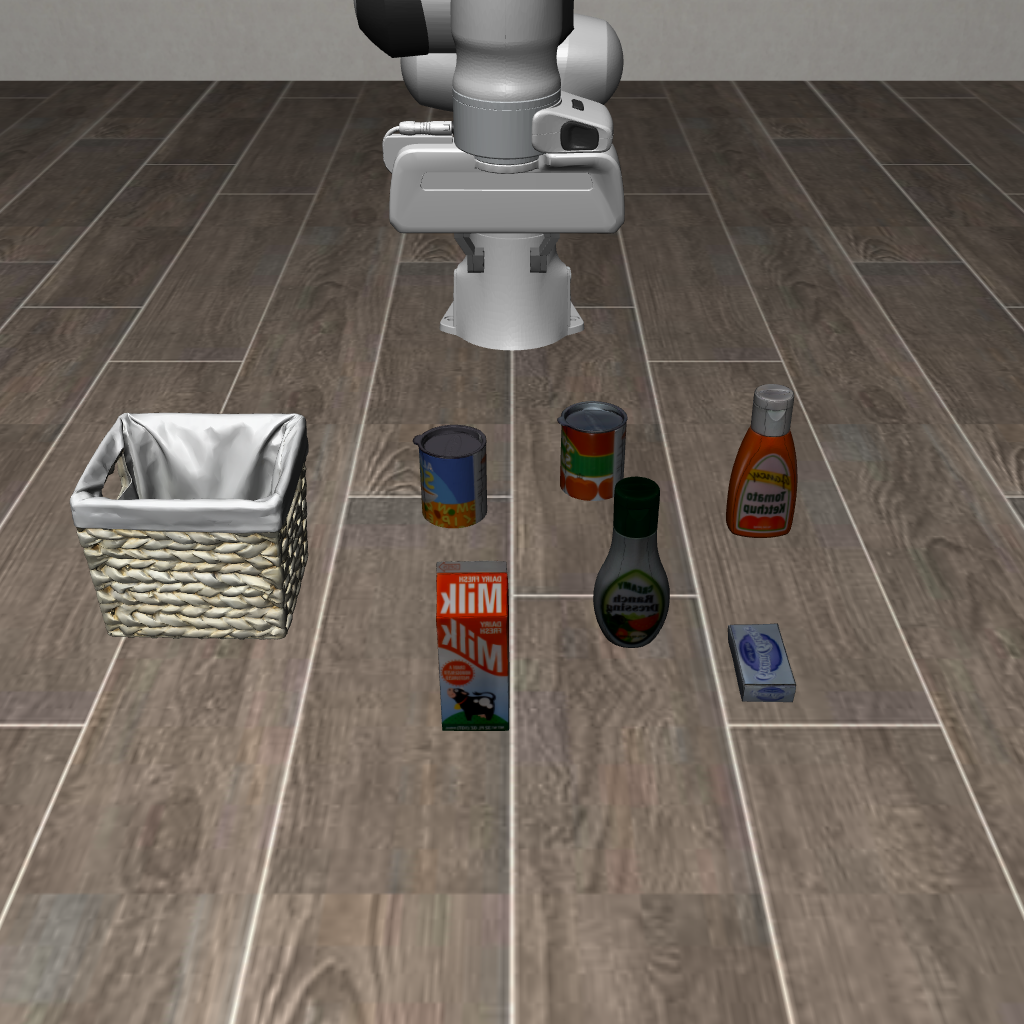
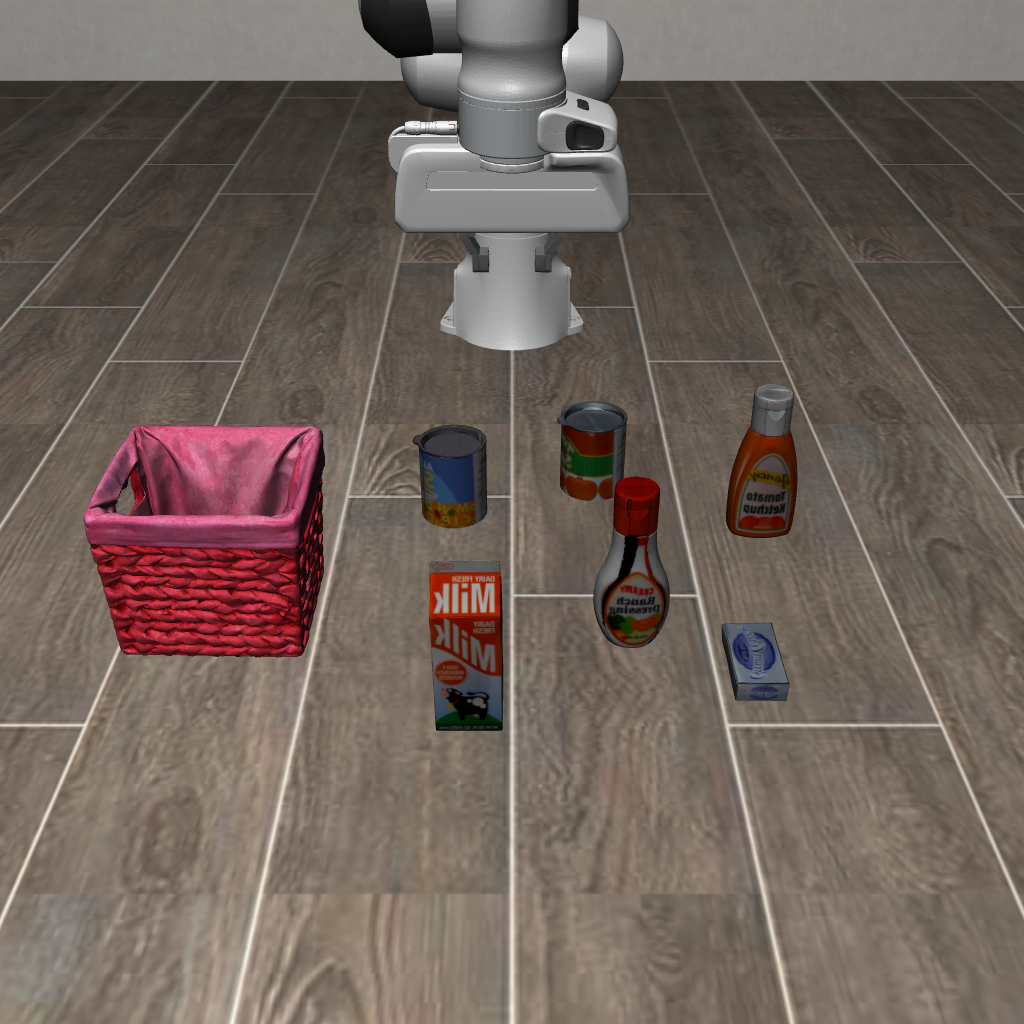
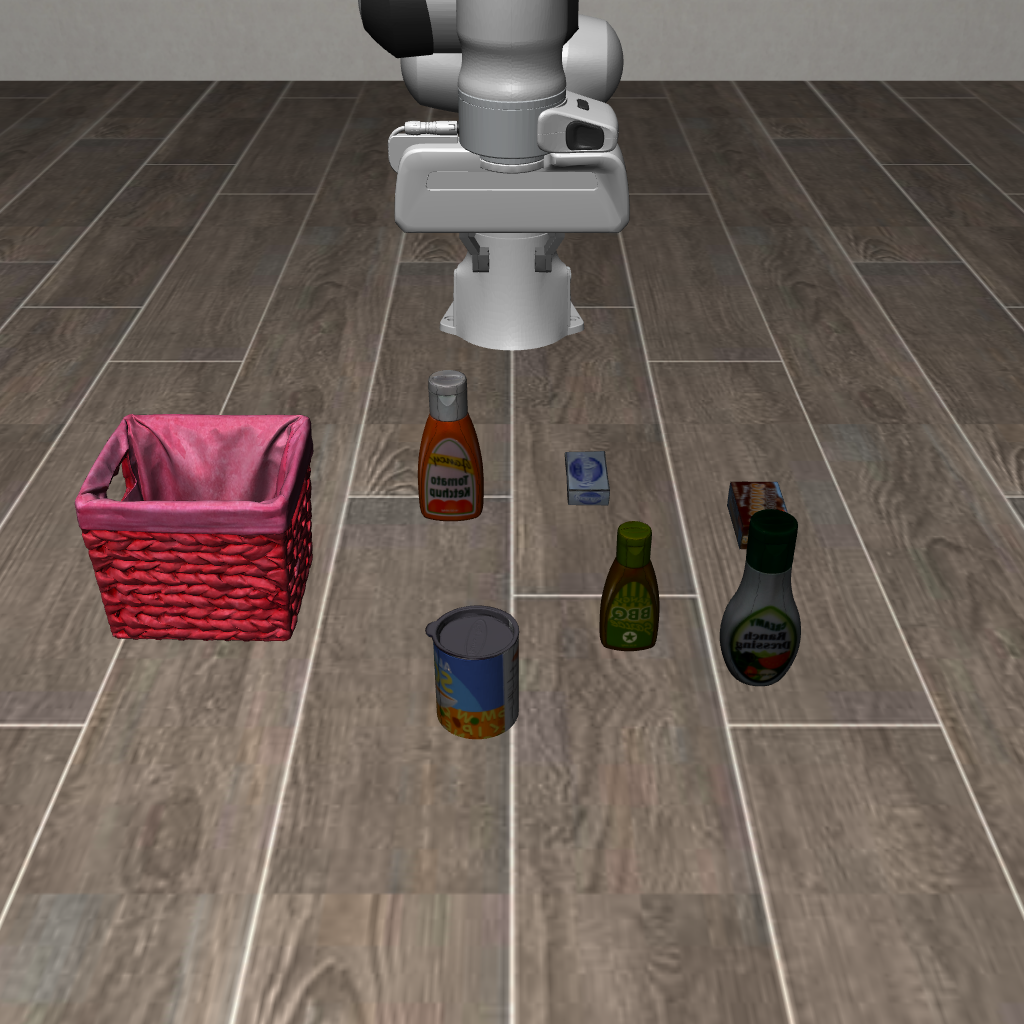
LIBERO-PRO Object Generalization trains the policy on a task with a given object, then at test swaps that object for a new one that can differ in size, shape, color, or other characteristics. On the same episode, Standard BC fails while Anchor-Align succeeds.
Pick up the alphabet soup and place it in the basket.1/3
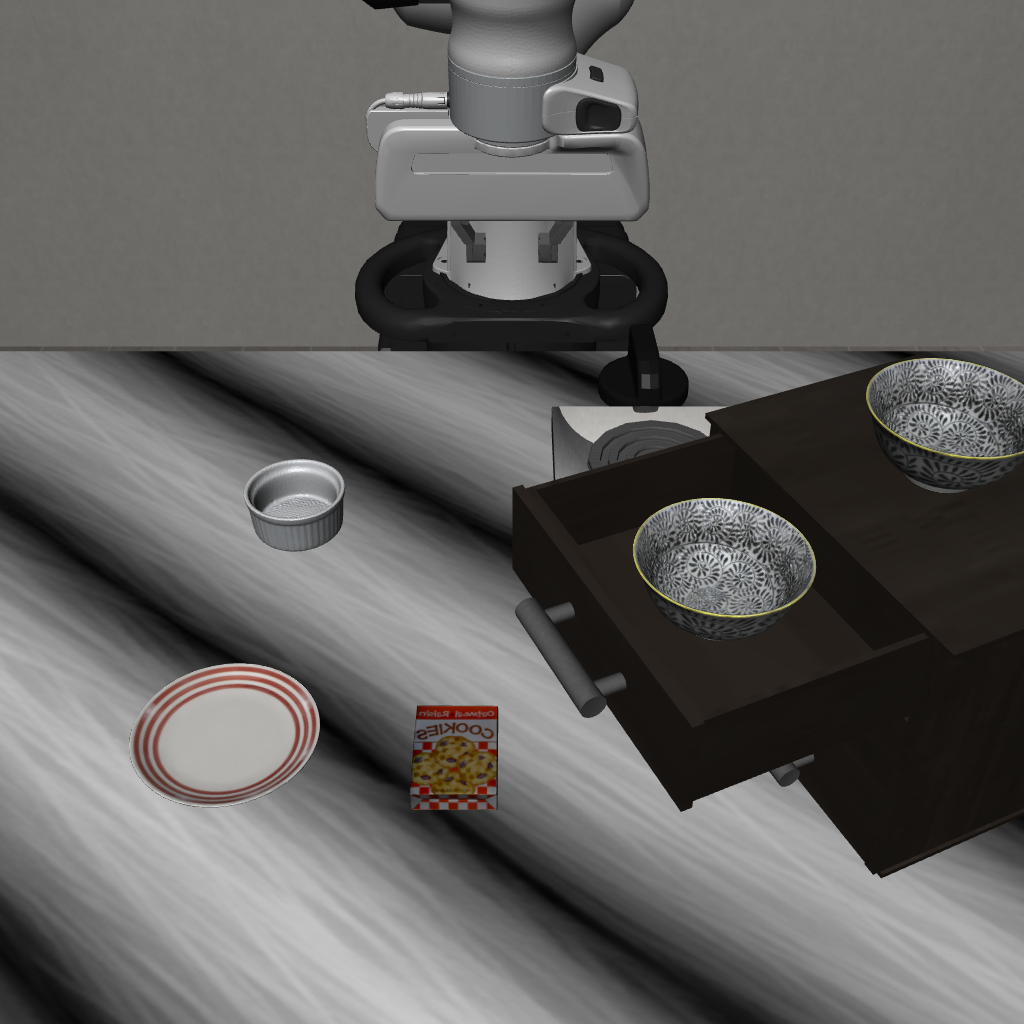
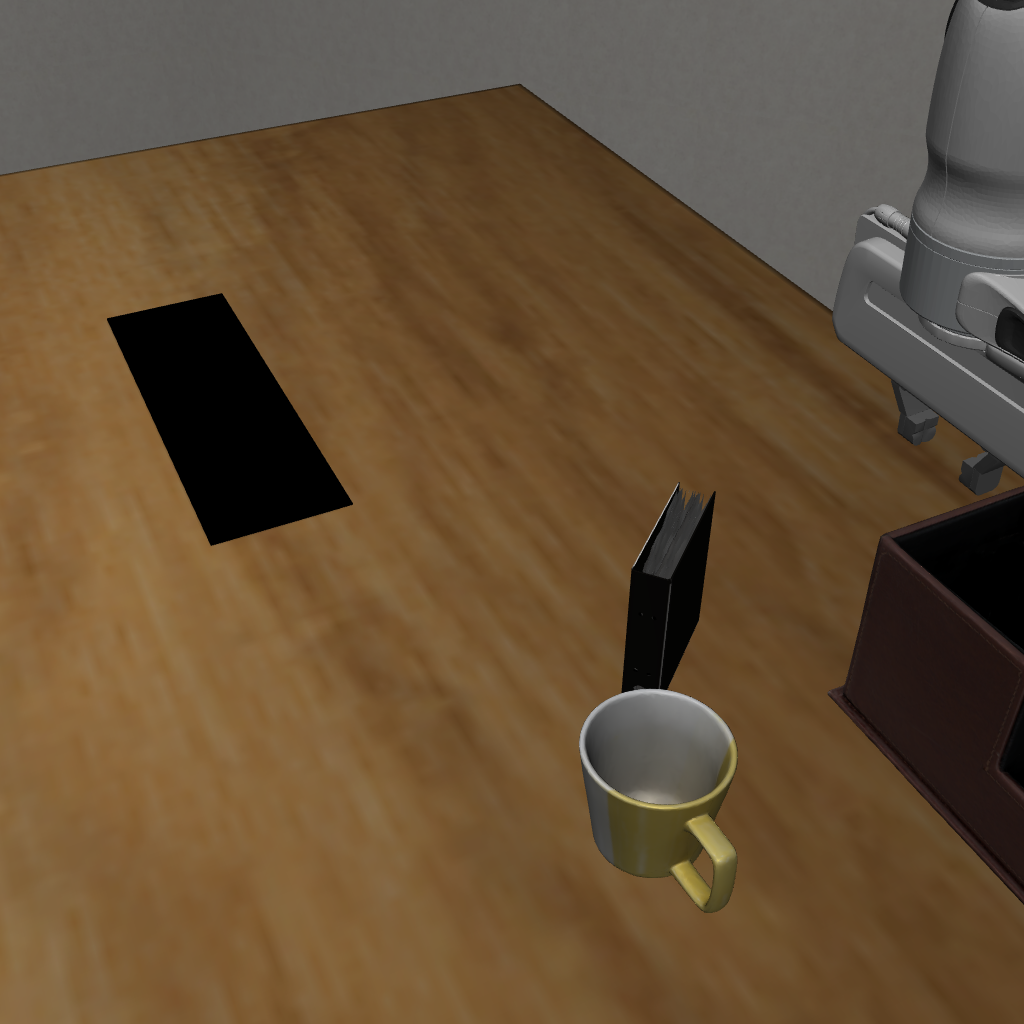
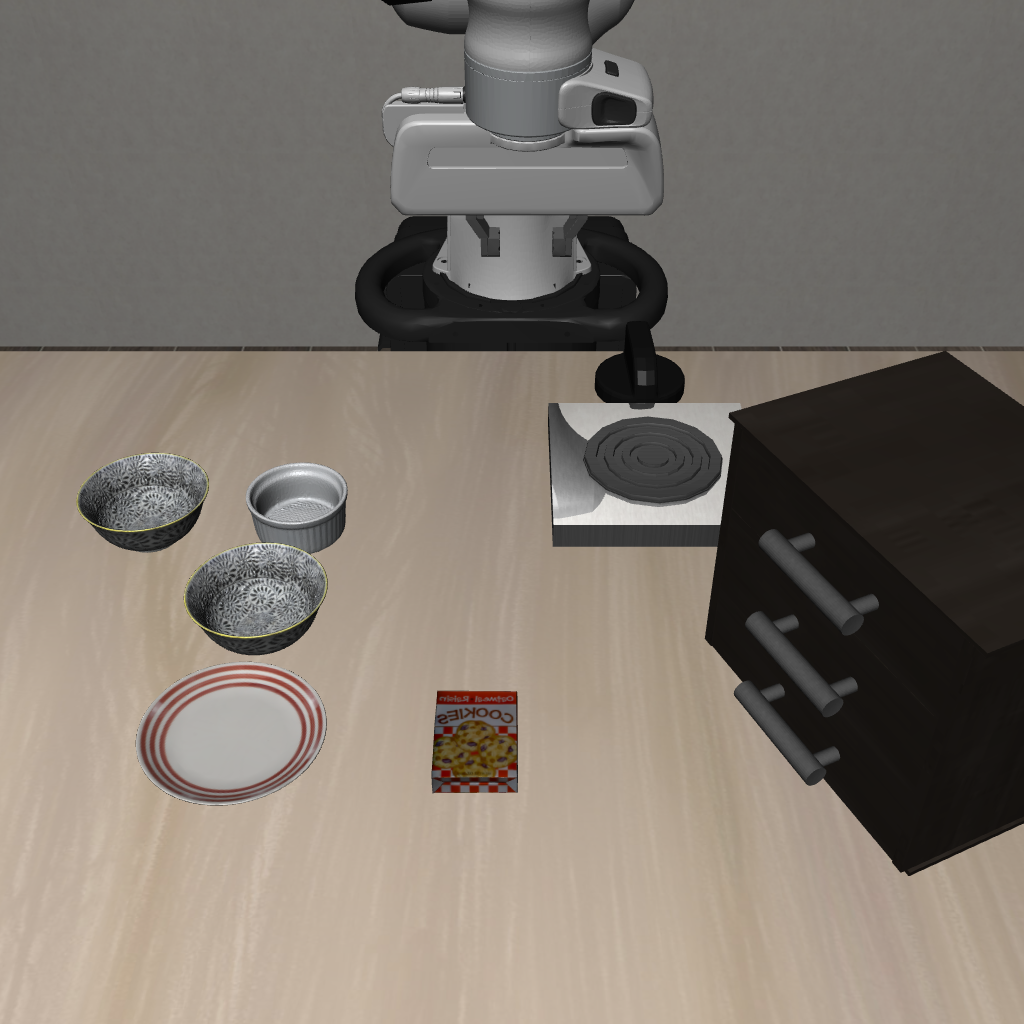
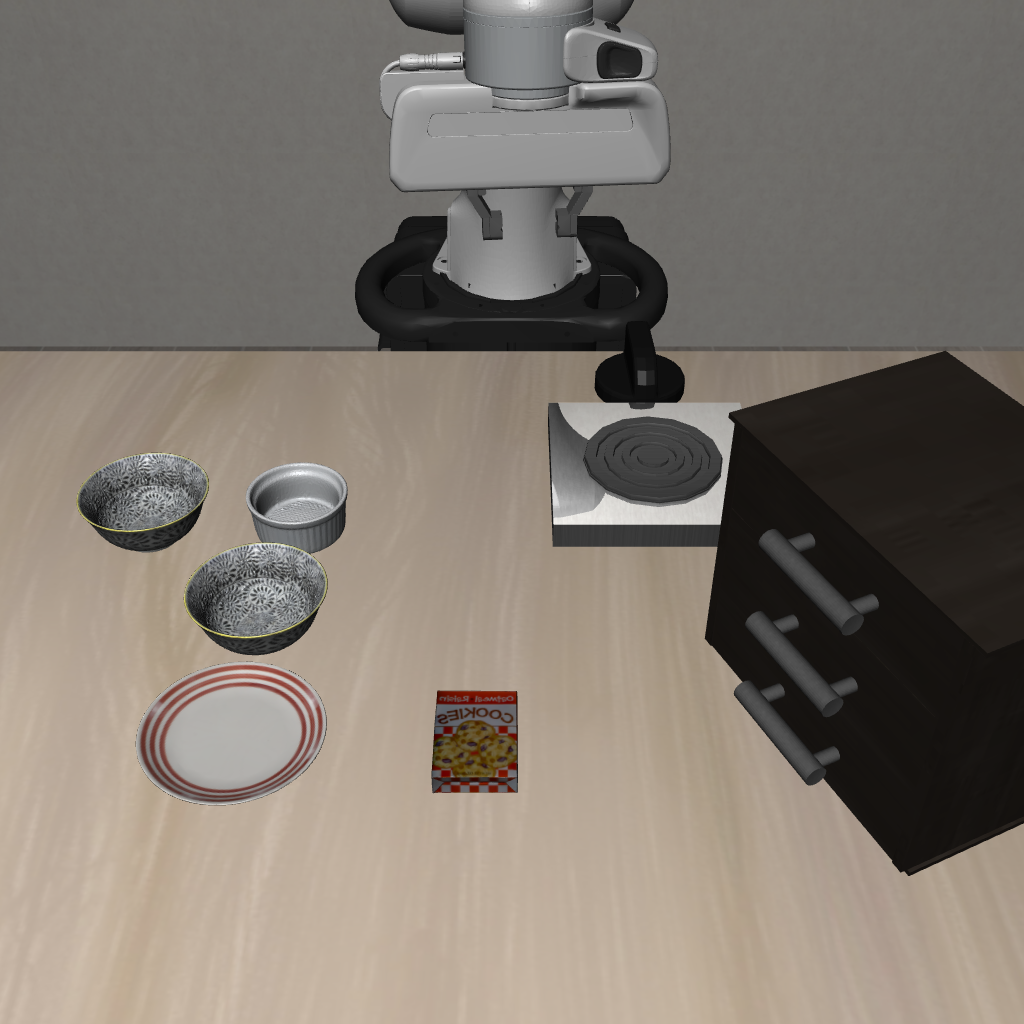
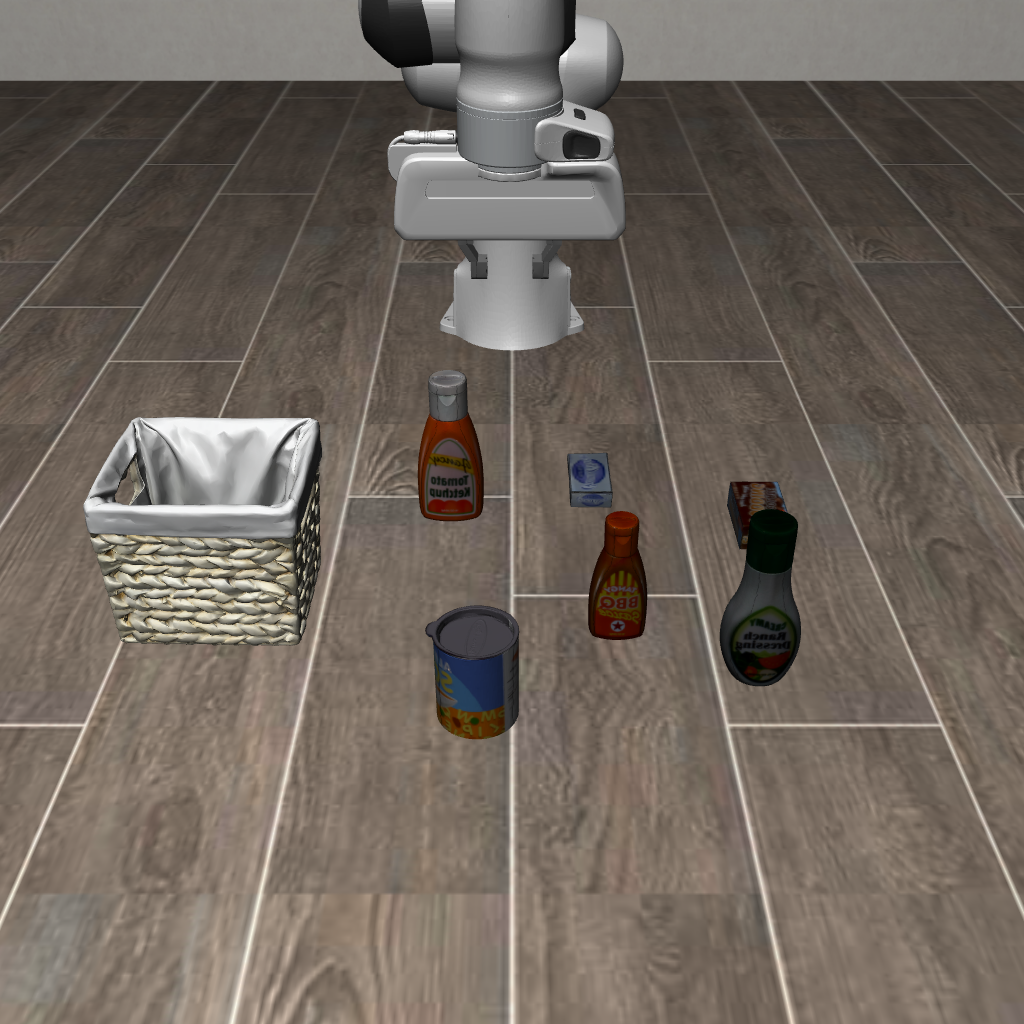
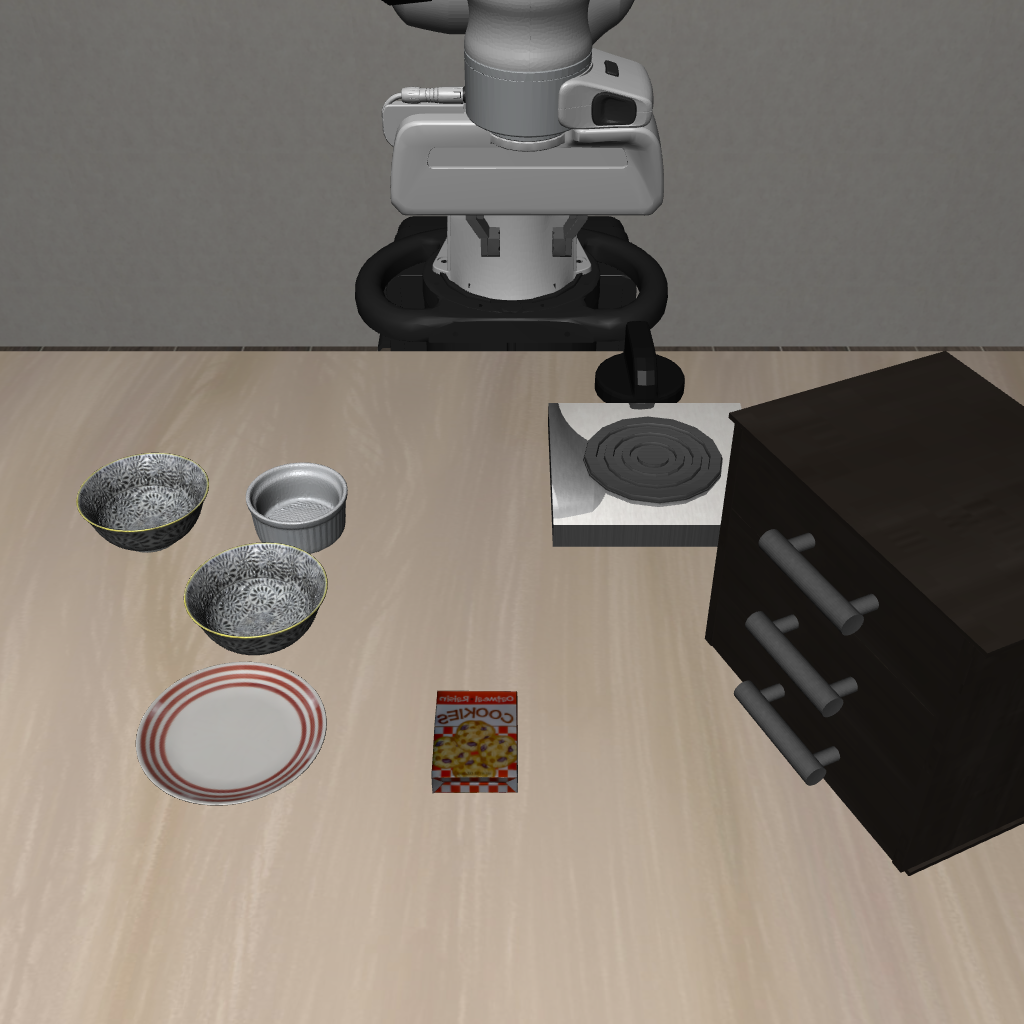
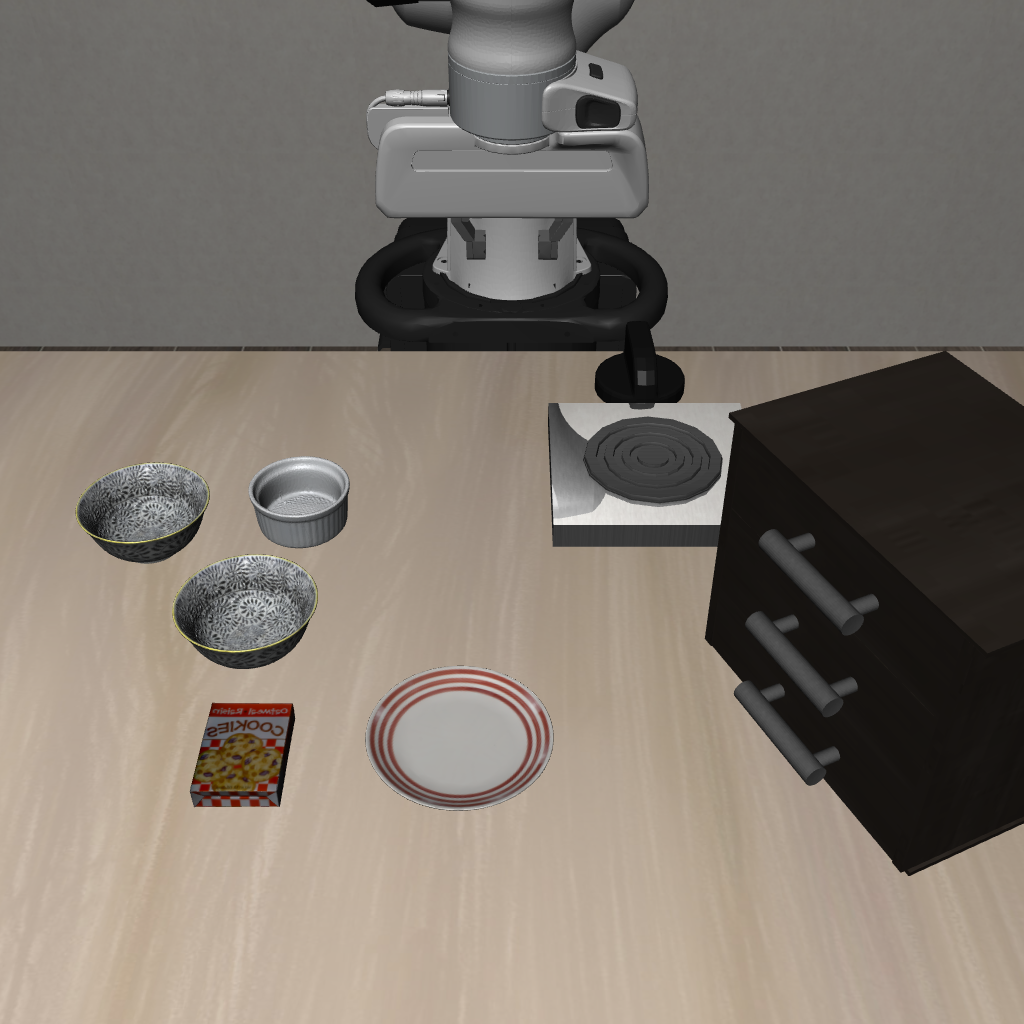
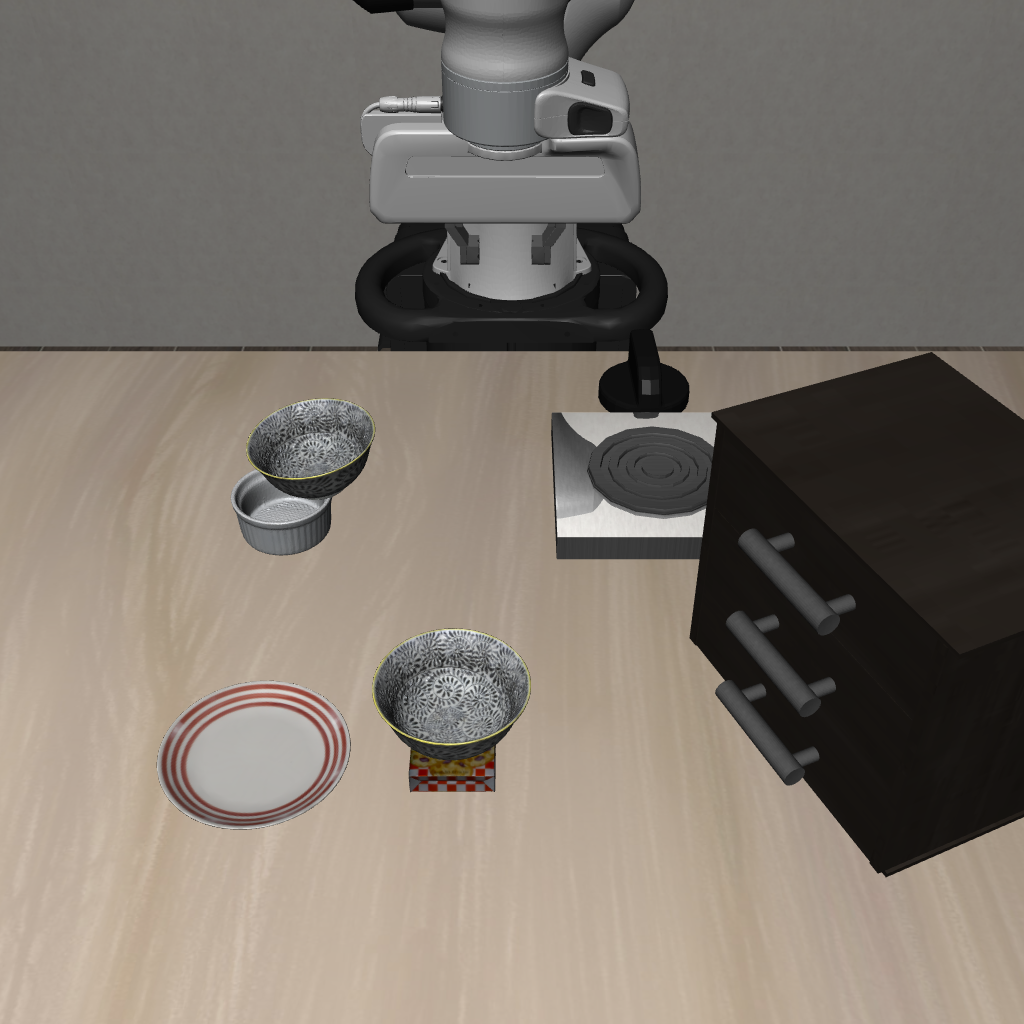
LIBERO-PRO Position Swap trains the policy with the task objects in their original positions and evaluates it after those positions are permuted, so completing the task requires acting on the objects' current locations rather than replaying a memorized trajectory. We pair the same held-out episode under Standard BC (failure) and Anchor-Align (success); each pair is a different task.
Pick up the black bowl between the plate and the ramekin and place it on the plate.1/2
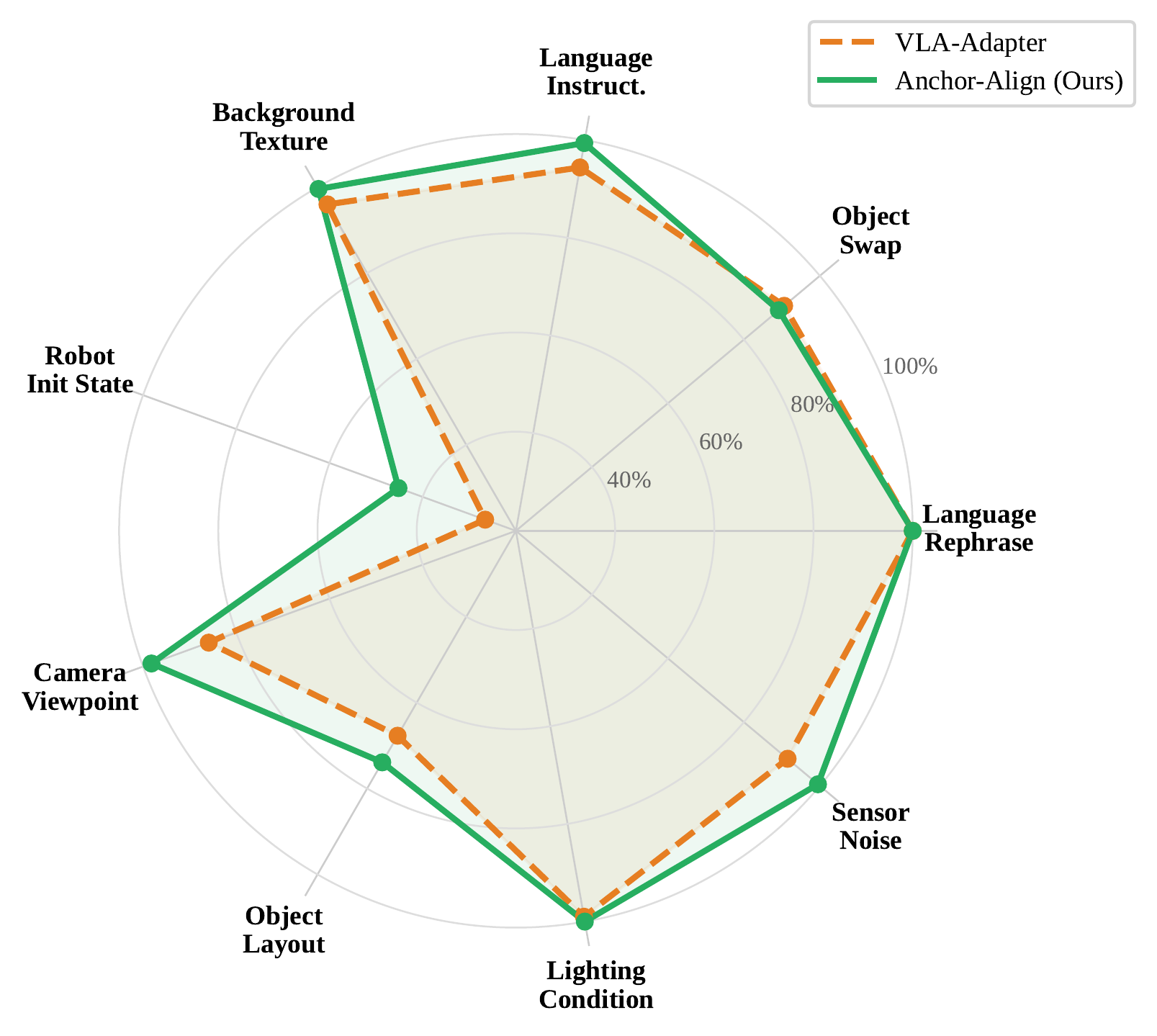
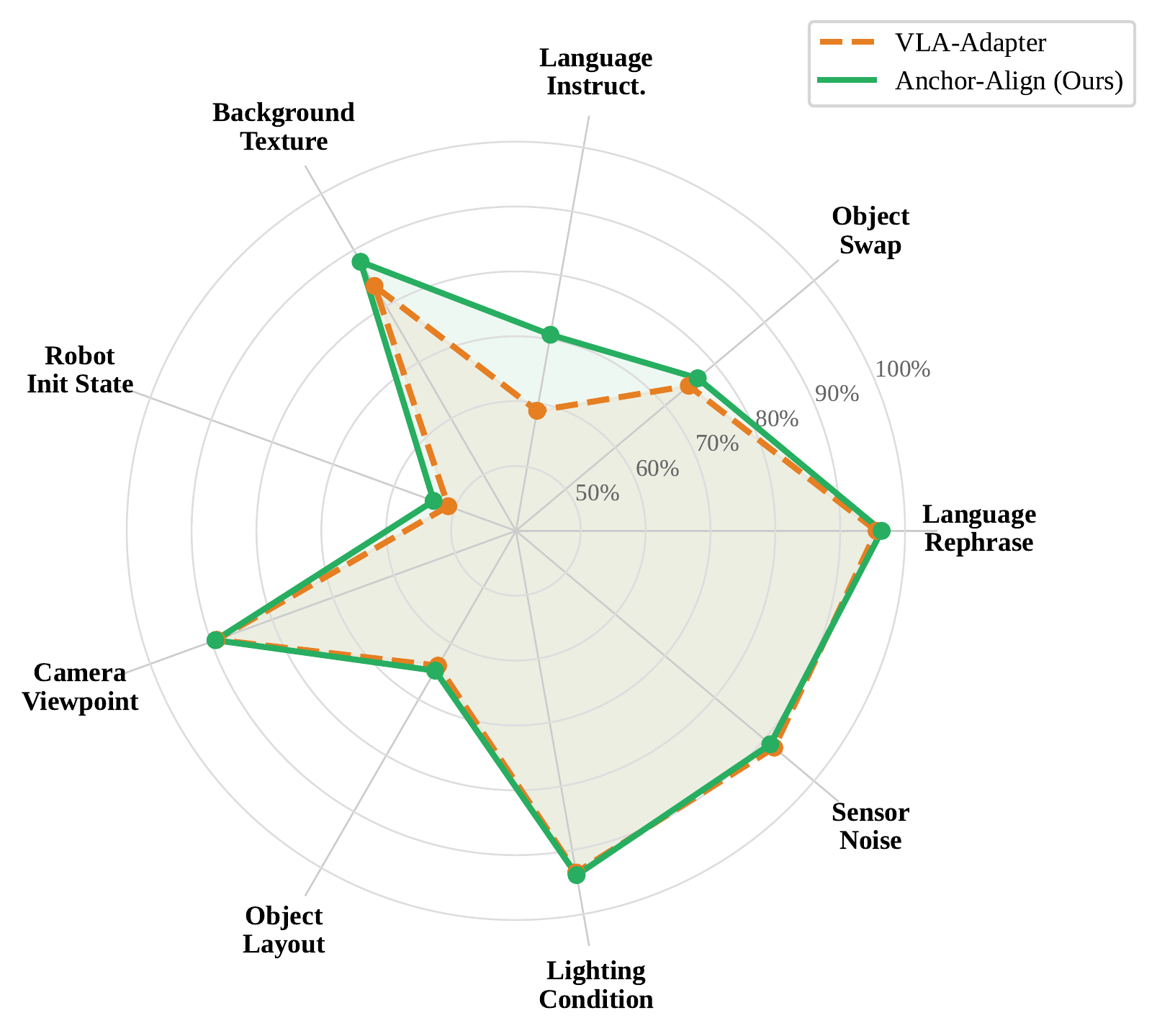
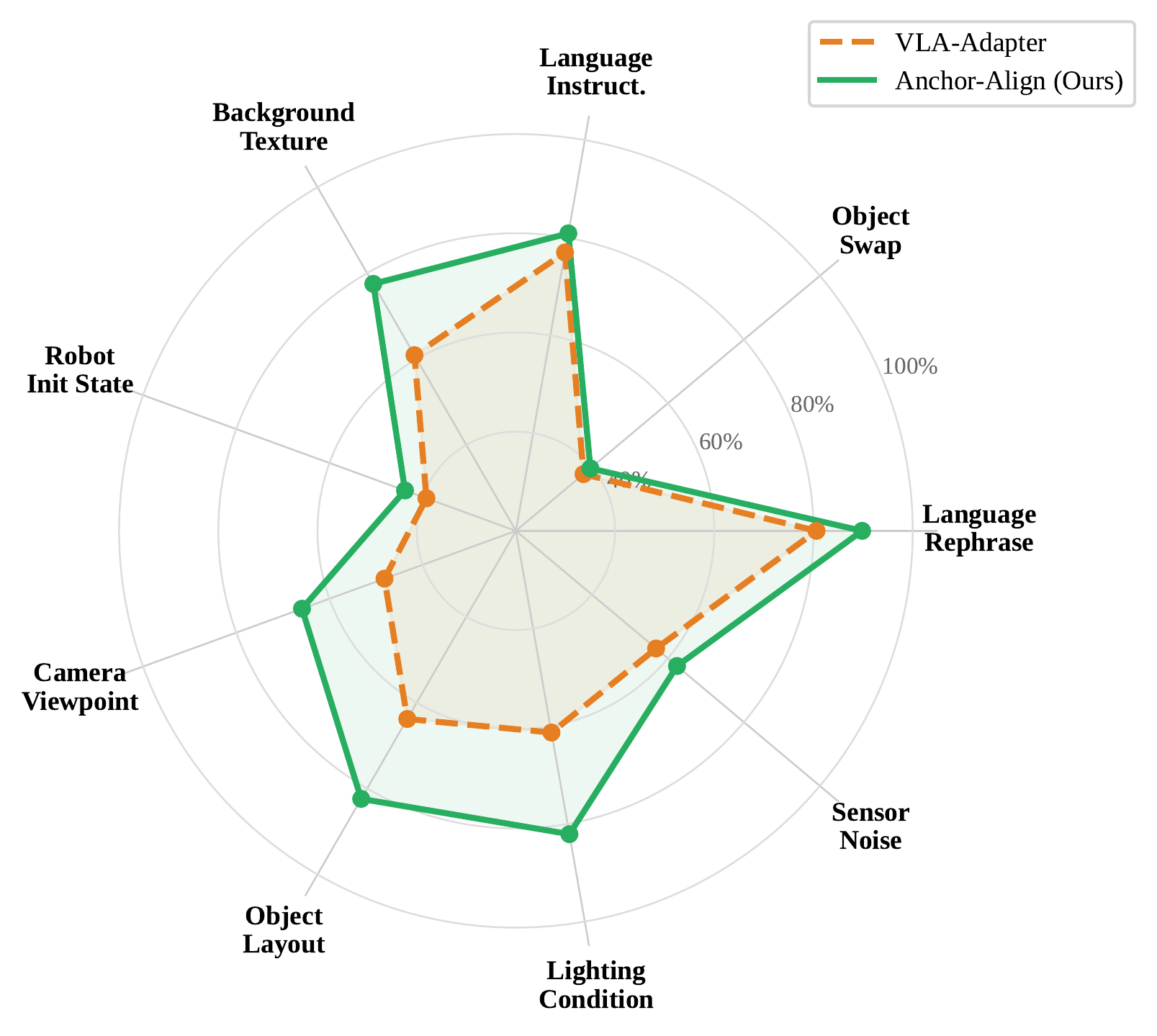
Table 1. Success rates (%) on the LIBERO-PRO and LIBERO-Plus benchmarks. Anchor-Align VLA achieves the highest mean on both benchmarks. The best result in each column is bolded and the second-best is underlined.
Method
LIBERO-PRO
LIBERO-Plus
Lang. Reph.
Object Swap
Pos. Swap
Mean
Lang. Instr.
Bg. Text.
Robot Init
Cam. View
Obj. Layout
Light Cond.
Sensor Noise
Mean
MolmoAct
77.8
82.4
0.0
53.4
79.5
84.1
47.4
10.1
76.5
77.4
53.4
59.9
VLA-0
75.4
93.0
5.4
57.9
60.0
70.2
34.9
42.6
83.9
88.7
60.1
62.0
OpenVLA-OFT
74.4
95.2
0.0
56.5
81.5
95.7
40.3
94.7
88.6
95.5
28.2
74.1
VLA-Adapter
91.1
89.6
2.3
61.0
85.1
90.7
52.6
92.6
93.2
93.2
89.5
85.1
VLA-Adapter [Frozen]
56.0
73.4
0.0
43.1
41.5
70.9
35.1
94.4
62.3
84.9
36.2
59.9
Co-training + KI
53.6
92.0
0.0
48.5
61.5
93.8
48.6
89.6
77.1
96.9
48.4
72.4
LAP
93.2
95.0
12.4
66.9
88.1
99.2
54.0
72.6
92.5
95.5
76.1
81.8
MAPS
93.0
90.2
11.6
64.9
87.1
97.3
52.9
95.2
87.5
97.3
90.6
86.3
Anchor-Align VLA (ours)
97.0
96.2
22.6
71.9
87.2
99.6
59.1
96.3
97.4
99.0
96.9
90.3
Each radar plot compares Anchor-Align (green) against the standard BC VLA-Adapter
baseline (orange, dashed) across nine evaluation axes: two from LIBERO-PRO (Language Rephrase, Object Swap)
and seven from LIBERO-Plus. Left to right: LIBERO-Object, LIBERO-Goal, LIBERO-Long.
BibTeX
@article{dalal2026anchoralign,
  title   = {Generalizable VLA Finetuning via Representation Anchoring and Language-Action Alignment},
  author  = {Dalal, Dwip and Patel, Shivansh and Jain, Chahit and Kim, Jeonghwan and Mishra, Utkarsh and Baratian, Alex and Ha, Hyeonjeong and Ji, Heng and Lazebnik, Svetlana and Jain, Unnat},
  journal = {arXiv preprint arXiv:2607.13429},
  year    = {2026}
}